

What if a school prize board could be searched as easily as a digital record, without losing the story behind each award? To transcribe school prize boards well, capture more than names: retain each award title, year and any useful context, then organise those details so they can be found later.
That can be difficult when inscriptions are faded, worn or obscured by reflections. Copying them by hand takes time, and a misread name or date can be easy to overlook. Yet the board records achievements worth keeping clear and accessible.
This guide explains how to create a reliable digital record, from preparing source images to checking uncertain entries and preserving original details. You’ll learn how to structure names, award titles and years so the archive is easier to search, share and maintain.
We’ll also cover how AI-assisted transcription can help extract details from board photographs, why checking suggested readings matters, and how searchable records and CSV exports make school history easier to use. The aim is a clear, dependable archive that honours both the achievement and its context.
Key Takeaways
- Learn why school prize boards are valuable historical records, and how a structured digital version can keep their achievements accessible.
- Follow a practical workflow to transcribe school prize boards, from gathering source images to organising and publishing the records.
- See how to handle hard-to-read names, dates and award titles by checking suggested readings against the image and surrounding entries.
- Choose consistent record fields so achievements are easier to search, maintain and reuse in a spreadsheet or digital archive.
- Explore how AI-assisted transcription can help create searchable archive entries, with review helping keep details accurate.
Why transcribe school prize boards into digital records?
Transcribing a school prize board means turning its visible names, award titles and years into accurate, structured digital records that can be searched and reused. Instead of leaving each achievement readable only on the physical board, organise its details into consistent fields. This makes it easier to find a recipient or award without changing what the inscription says.
Prize boards hold more than a sequence of winners. They record school achievements, traditions and the names of people connected to the school over time. A record of an annual prize, for example, can show how an award has continued, while house or team labels can preserve how the school recognised success. Digitising these entries gives people another way to explore and share that history.
Transcription is distinct from photographing, restoring or replacing the board. A photograph captures its appearance; transcription captures information as structured text. It doesn’t repair worn lettering or alter the original object. Instead, it creates a companion record, with the board remaining the historical source. The general meaning of Transcription (linguistics) also centres on representing material in another form, though board transcription focuses on visible inscriptions.
What information should a school prize-board transcription capture?
Start with the details that identify each entry. Record what is visible, then add labels that help explain how the award was given. Keep the original wording and spelling, even if an older form looks unfamiliar. Correcting it in the transcription can hide useful evidence about the period or the board’s conventions.
- Recipient: the name as inscribed, including initials or unusual spelling.
- Award: the prize, event or achievement title as written.
- Year: the associated year, preserving its displayed format.
- Context: house, team, form or category labels where they clarify the entry.
What makes school prize boards difficult to transcribe?
Legibility can vary across a single board. Small lettering may be hard to distinguish, reflective surfaces can obscure characters, and faded inscriptions may leave only parts of a name or date clear. Abbreviations create another challenge: initials or shortened award titles may be readable but difficult to interpret.
Keep visible-text problems separate from gaps in historical context. If a letter is unclear, mark the reading for review against the source rather than guessing. If the inscription is legible but doesn’t explain an abbreviated title, record the wording as it appears and note the uncertainty separately. A missing entry or date is also different from an unreadable one: don’t fill a gap with an assumption. This distinction keeps the digital record faithful to the available evidence.
How to transcribe a school prize board: source to record
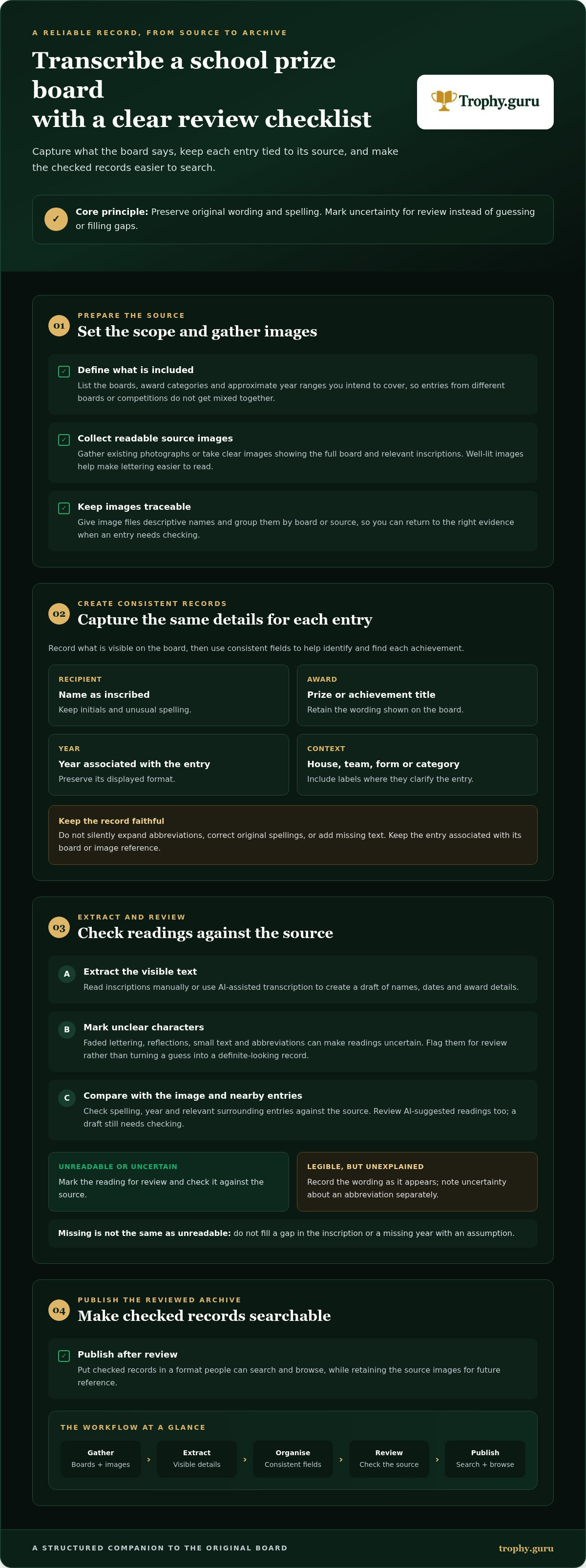
A dependable transcription starts with an organised source, not a guess about what an inscription might say. To transcribe school prize boards accurately, gather the relevant images, extract the visible text, arrange each result into consistent fields, review uncertain readings and publish the checked records. Keep each entry connected to its source board or image so readers can trace a digital detail back to the evidence.
In short, move from board to searchable archive by collecting clear images, structuring each inscription, checking it against the source and publishing the reviewed record. Clear, well-lit photographs make lettering easier to read. They’re a practical starting point, not a replacement for review, particularly when a board is reflective or its engraving is worn. This sequence gives schools a reliable way to transcribe school prize boards while retaining useful links to the source material.
Prepare board information for transcription
First, define the scope. List the boards, award categories and approximate year ranges you intend to include. This sets a clear boundary and helps prevent entries from different boards or competitions being mixed together. Gather existing photographs or take readable images that show the full board and relevant inscriptions. Give files descriptive names, then group them by board or source so you can return to the right image when a reading needs checking.
Turn visible inscriptions into structured entries
Use the same fields for every result. A simple record might include winner, award title, year and any school, house or competition context needed to identify the entry. Preserve the wording on the board; don’t fill in missing text or silently expand abbreviations. Mark unclear characters for review so uncertainty stays visible rather than becoming a confident-looking error.
- Gather: Make an inventory of boards and collect their source images.
- Extract: Read the inscriptions manually or use AI-assisted transcription to create a draft of names, dates and award details.
- Organise: Put each result into consistent fields and associate it with its board or image reference.
- Review: Compare uncertain readings with the source, checking spelling, year and relevant surrounding entries.
- Publish: Once checked, put records in a format people can search and browse, while retaining the source material for future reference.
This methodical approach reflects guidance from the National Archives Citizen Archivist program, which treats transcription as a way to make records more accessible and searchable. For a prize board, the same principle means a name or award can be found by its details while remaining linked to the evidence it came from.
Keep a clear distinction between a draft and a reviewed entry. AI can help organise the work by extracting text from uploaded photographs, but check the transcription against the image before treating it as confirmed. If an inscription remains uncertain, preserve that uncertainty in your working record rather than guessing. This makes later review more reliable and protects the integrity of the archive.
For schools moving from source images to searchable records, Trophy Guru’s AI-assisted transcription can extract names, years and details from trophy and honours-board photographs, helping organise them into digital archive entries.
How to handle unclear names, dates and award titles
Faded lettering, reflections and worn surfaces can leave more than one possible reading. AI-assisted transcription can help turn board photographs into draft text, but a suggested name or date isn’t confirmed just because it looks plausible. Treat uncertain entries as questions to resolve, not gaps to complete from memory.
Preserve uncertainty rather than inventing a historically plausible answer. This keeps the digital record faithful to the board and makes clear which details still need review. It’s especially important when transcribing school prize boards, where a small difference in a surname, year or award title can change the historical record.
Review names and dates against the original board
Return to the source image for every uncertain character. Compare the shape of a letter with other letters on the same board, and inspect year digits individually. A nearby name or a repeated award may provide useful context, but it can’t prove a disputed reading. If the inscription remains obscured, mark the text as illegible or partially unreadable rather than choosing the likeliest name.
Keep a review note separate from the transcription itself. For example, record that the final letter of a surname is unclear, or that a year could be read as either of two digits. This lets another reviewer understand the uncertainty without mistaking a working guess for confirmed text. If a clearer source later becomes available, update the entry and note why the reading changed.
Preserve changing award names and school terminology
Use the wording on the board as the primary record, even if a title seems old-fashioned or differs from the school’s current terminology. If the meaning needs explaining, add that explanation in a separate context field instead of rewriting the inscription. Keep similar-sounding awards distinct unless the source establishes that they refer to the same prize.
This separation protects accuracy and searchability. A reader can search the wording that appears on the board, while an optional note explains a historical term. Don’t silently expand abbreviations or merge award titles based only on an assumption.
For each uncertain entry, use a consistent review process:
- Identify the exact part that’s unclear, such as a letter, digit or abbreviated title.
- Compare it with the source image and, where useful, similar lettering elsewhere on the board.
- Record the visible text as faithfully as possible and keep unresolved details clearly marked.
- Confirm only when the source supports a reading; otherwise retain the uncertainty.
Consistency matters more than making every field look complete. A clearly marked unknown tells future readers what the evidence does and doesn’t show. A guessed answer can look certain and may be repeated in later records, making it harder to correct. Keep the image reference, transcription and review note together so the reasoning remains traceable.
How to organise and review transcribed school prize-board records
Once entries are transcribed, the storage format affects how easily people can use them. A transcription sheet can work as a temporary working record, but it may be awkward to search or update. A spreadsheet makes it simpler to sort entries by recipient, award or year, though it relies on consistent formatting and careful maintenance. A searchable digital archive supports browsing, while CSV export lets you reuse records in other data workflows.
As you transcribe school prize boards, choose a format based on who needs the records and how they’ll use them. A spreadsheet might suit staff checking entries before publication; an archive can make browsing easier for a wider audience. You can use both. Whichever you choose, keep a reference to the source board or image with each record. That makes later checking easier and gives historical research a route back to its evidence.
Choose fields that make prize-board records useful
Use separate fields for recipient, award title and year, with additional categories such as house, team or competition where they help identify an entry. Add a source-board reference too. Consistent field names and date formatting make records easier to sort and search, but keep the inscription’s original wording in the award field. Uniform formatting should organise the information, not rewrite it.
Keep explanatory notes distinct from the transcribed text. If a title or school term needs clarification, a note can supply context without changing the historical wording. This is useful when terminology has changed or similar awards need to remain separate.
Review records before sharing them
Before sharing, check the records as a set as well as entry by entry. Compare names and dates with their sources, look for duplicate entries, and check whether any visible results were missed. Similar names or awards don’t automatically indicate duplicates, so verify each case against its board or source image.
- Spelling and dates: Check transcribed details against the source, especially entries previously marked for review.
- Duplicates: Investigate repeated names and awards without merging records unless the evidence supports it.
- Completeness: Confirm each source entry has been considered, distinguishing unreadable text from an overlooked record.
- Traceability: Retain the board or image reference so future reviewers can check the evidence.
- Reader context: Include relevant categories so an achievement makes sense beyond the recipient’s name.
If your school plans to transcribe school prize boards in batches, use the same fields and review approach throughout. Consider who needs access and what context will help them understand the entries. Staff may need sortable data for ongoing updates, while pupils, former pupils and families may value an archive that’s easy to browse. A broader school trophy-record digitisation plan can help keep related records organised consistently.
To organise reviewed entries in a searchable archive and reuse them through CSV export, create a digital prize-board record with Trophy Guru.
Use Trophy Guru to create a searchable school prize-board archive
Once your source material is ready, Trophy Guru can turn photographs of school prize boards, plaques and related records into organised digital entries. Its AI-assisted transcription extracts names, years and other visible details, giving you text to review rather than requiring every inscription to be typed from scratch. This supports the work to transcribe school prize boards while keeping the original image available as a reference.
From uploaded board photograph to searchable record
Upload a source photograph and AI-assisted processing identifies visible names, dates and award details. Review the proposed entries against the source before treating them as confirmed. That check matters: reflections, worn lettering or unusual spellings can affect a reading, and the board itself remains the evidence for what should appear in the record.
Reviewed details can become entries in a searchable online archive. Instead of scanning a photograph or a long document to find a particular achievement, users can search and browse digitised records using the information captured in each entry. The archive makes school awards easier to explore while retaining their connection to the original board.
Transcribed information can also be exported as a CSV file. This gives the school a reusable record for other data workflows, such as working with entries in a spreadsheet. Keep field names and spellings consistent, and retain source references as part of your review process so records remain useful beyond the archive itself.
Try a first transcription and plan the next batch
Trophy Guru offers one initial trophy transcription free, giving you a practical way to try AI-assisted extraction and review. To plan a school-board project, choose a representative board or record and decide which details you want to capture. Starting with a clearly defined source helps you see how the resulting data fits your fields and review process before organising a wider batch.
From there, plan the next group of source material by board, award category or year range. Keep the scope manageable, and use the same record structure across each batch. That makes later searching and checking more consistent. For instance, if you record recipient, award title, year and house for one board, applying those fields to the next helps maintain a coherent archive.
The aim isn’t simply to convert lettering into text. It’s to make each entry findable, reusable and faithful to the school record it came from. AI can reduce repetitive extraction work, while careful review helps prevent names, dates and award details from being accepted without checking.
When you’re ready to begin, prepare a representative source image and use Trophy Guru’s transcription workflow to start shaping your school’s prize-board history into searchable records.
Give your school’s achievements a lasting place
A prize board records more than a moment of success. It reflects the people, traditions and values a school has carried forward, and a carefully maintained digital record can help keep that story connected to future generations. The next step doesn’t need to be a large project. Choose a manageable starting point, agree how new entries will be maintained, and make preservation part of the school’s ongoing record-keeping.
As you transcribe school prize boards, keep the aim in view: make achievements easier to find while respecting the history behind each entry. A first transcription can help you see how the process fits your school’s records and what you’d like to do next.
Try one trophy transcription free with Trophy Guru and take a practical first step towards preserving your school’s prize-board history. Each carefully kept record makes those achievements easier to rediscover.
Frequently Asked Questions
Can AI transcribe names from a school prize board?
Yes. AI-assisted transcription can extract names, years and other details from uploaded photographs of school prize boards. Treat the result as a draft, particularly if the source has small lettering, glare or unusual spellings. Compare uncertain entries with the image before approving them. Trophy Guru uses this approach to help turn board details into digital records, while review helps confirm what the inscription actually says.
How do I transcribe a school prize board from an old photograph?
Start with the clearest original image available, rather than a screenshot or compressed copy if you have a better source. Check that the image includes the relevant inscription and identify which board it shows. Then type the visible details into consistent fields or upload the photograph for AI-assisted transcription. Compare the proposed text with the image, and keep the original photograph alongside the resulting record for reference.
What should I do when a name or date on a prize board is unreadable?
Don’t fill an unreadable section with a likely answer. Record the legible part and mark the rest as unclear, such as a surname with one uncertain letter or a year with an obscured digit. If another source later helps establish the reading, note what supports the change. This gives future readers a clear distinction between what the board shows and what later research has added.
Can a school prize-board transcription preserve the original spelling?
Yes. Transcribe each name and award title as it appears, including historical spellings, initials and punctuation where visible. For instance, if a surname has an unexpected spelling, retain it in the transcription rather than silently correcting it to match a modern school record. If you want to help readers find a current or alternative spelling, add it in a separate note or search field, keeping the inscription itself unchanged.
How can I record a prize winner whose name appears differently across years?
Keep each year’s inscription as its own record, preserving the name exactly as shown. If you have reliable evidence that the entries refer to the same person, you can add a separate identity note linking the variations. For example, one board might use initials while another spells out a first name. Don’t merge records based on a similar surname alone, since different people may share a name.
Can school prize-board records include team, house and individual awards?
Yes. Add a category or award-type field so team, house and individual achievements can be distinguished without changing the wording on the board. For a team prize, record the team name as the recipient if that’s what the inscription shows; don’t infer individual winners unless the board names them. Consistent categories make it easier to find a particular type of achievement across different years or boards.
Is a digital transcription a replacement for the original school honours board?
No. A transcription is a companion record, not a substitute for the physical honours board. The original remains the source for its material, layout and inscriptions, while the digital version makes details easier to search and reuse. Keep existing photographs or other source references connected to the records. That way, someone exploring an entry can return to the evidence and understand the digital text in its original context.


