

What if the names on your club’s trophies could be searched and shared without weeks of manual transcription? Community club heritage archiving can turn engraved records and honours boards into a practical digital resource, while helping protect their stories from damage, fire or theft. A trophy cabinet preserves the objects, but if members can’t easily find or access the records, much of that history stays out of reach.
This guide explains how to plan a digital archive, from taking stock of records to making them searchable and keeping a separate copy of the data. You’ll learn how AI-assisted transcription can extract names and years from photos, and how a digital honours board and CSV export can help members and alumni explore club achievements. We’ll also cover how to check transcriptions, organize access and keep the archive current, so your club’s heritage remains useful and visible.
Key Takeaways
- Start community club heritage archiving with an inventory, prioritising records at risk of damage or especially meaningful to members.
- Take clear photographs of engravings and honours boards to create a practical starting point for digital records.
- Plan for searchable honours records, not just a gallery of images, so members can find past winners and achievements.
- Invite former and current members to contribute photographs and context, helping preserve details that might otherwise be lost.
- Use AI-assisted transcription to reduce manual data entry, then review names and years against the source image.
The Critical Need for Community Club Heritage Archiving
A trophy or honours board records more than a result. It carries names, milestones and traditions that help members understand what their club values. But physical records can be damaged or become difficult to read and access. Community club heritage archiving helps preserve those records and make them useful to the people whose history they represent.
There’s also a risk that knowledge lives only with long-serving members. They may remember why a competition began, recognize a name on an old cup or know where earlier records are stored. When they move on, those details can disappear with them. Recording names, dates and relevant context in a shared archive gives the next committee a reliable starting point, rather than leaving them to reconstruct the past from memory.
Community-led archives are built around the histories people value and contribute. The overview of What are Community Archives? explains this approach and its development. For a club, the practical aim is to preserve records in a way members can find, understand and add to.
Risks to Physical Heritage Records
Wooden boards can fade under prolonged exposure to sunlight, while damp may affect their surfaces or the room where they’re stored. Metal engravings can tarnish and become harder to read. Accidents, fire and theft pose more immediate threats. These risks are a reason to create a usable record before damage makes names difficult to recover, not a reason to discard or neglect the originals.
There’s also the hidden-history problem. If honours are kept in a locked cabinet or a room members rarely enter, the collection may be physically present but absent from club life. A digital copy makes achievements easier to discover and share.
Benefits of a Digital-First Approach
A searchable honours board lets members look up a name on a phone instead of scanning rows of engraving. That’s useful at a club dinner when someone wants to find a past winner, and between events when alumni are reconnecting with the club. Digital records can also support anniversary posts, historical features and conversations across generations.
Plan for more than one copy of the archive. Keep an additional copy in a separate location and check periodically that the files remain accessible. A CSV export provides a practical copy of names and years that the club can retain and use alongside a hosted display.
Sharing past achievements can give current members a clearer sense of belonging and help alumni reconnect with traditions they helped build. A well-organized, searchable record makes the club’s heritage visible and easier to pass on, rather than leaving its history in the memories of a few people.
Transitioning from Physical Plaques to Digital Records
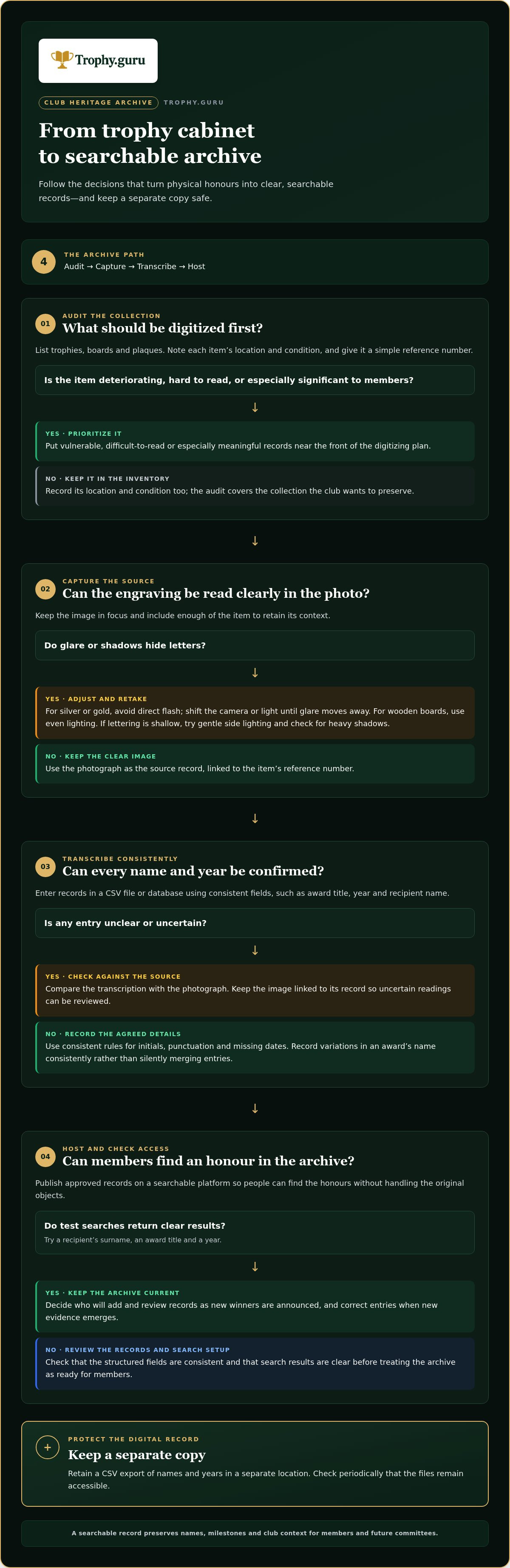
A useful archive is more than a folder of trophy photos. It turns each engraving into a consistent record that members can search, check and revisit. For community club heritage archiving, work through four stages: audit the collection, capture readable images, organize the details, then make the records accessible through a searchable platform.
Start with an audit, then capture clear images
List the trophies, boards and plaques your club wants to preserve. Note each item’s location and condition, then prioritize those that are deteriorating, hard to read or especially significant. Give each item a simple reference number so its photograph and transcription can be matched later.
When photographing silver or gold, avoid pointing a flash directly at the reflective surface. Move the camera or light source slightly until glare shifts away from the engraving, and take another view if reflections obscure letters. For wooden boards, use even lighting. A gentle light from the side can help reveal shallow lettering, but check that it doesn’t create heavy shadows. Keep the image in focus and include enough of the item to retain its context. These trophy photography tips for transcription can help you prepare clearer source images.
Turn images into organized, searchable records
A photograph preserves visual evidence, but it won’t let a member search for a name or sort winners by year. Transcribe the engraving into a CSV file or database, and link the image to its record so uncertain readings can be checked against the original.
Choose a consistent format before entering information. For example, use separate fields for award title, year and recipient name. Agree on how to record initials, punctuation and missing dates. If the same award appears under different names over time, record the variation consistently rather than silently merging entries. Clear, consistent fields make searches more dependable and help future volunteers understand the archive.
- Audit: Create an inventory and prioritize vulnerable or important items.
- Capture: Photograph each item clearly, adjusting the light and angle to reduce glare or reveal shallow engraving.
- Transcribe: Put names, years and award titles into consistent fields, then compare unclear entries with the source image.
- Host: Publish approved records on a searchable platform so members can find honours without handling the original objects.
Before launch, test the archive with realistic searches: try a recipient’s surname, an award title and a year. Check that the results are clear and that entries can be corrected when new evidence emerges. Keep a CSV export as a separate copy of the structured information, and decide who will add and review records as new winners are announced.
Once your source photos are ready, upload one to begin AI trophy transcription and turn engraved names and years into digital records. A searchable honours board can bring those records together for members to explore.
The Power of Searchable Honours Boards and Data Integrity
A digital honours board should do more than display trophy photographs. It connects award names, recipients and years in structured records, making club history searchable and easier to maintain. An image can show an engraving, but searchable data can answer questions such as who won a particular award or in which years a member’s name appears. For community club heritage archiving, the goal is useful access as well as preservation.
Make club history easy to explore
Picture a club dinner where a family wonders whether a grandparent once won the annual cup. With searchable records, members can look up a surname on a phone instead of trying to read every line on a crowded board. Families can discover connections, and alumni can revisit achievements from their time at the club. These moments help make an archive something members actively use.
Structured records can also support a clubhouse display or a virtual trophy room on the club website. A screen might show winners by year, while the online archive lets visitors explore names and awards at their own pace. Keep the display grounded in verified records, and add photographs or stories where the club has reliable context.
Protect accuracy and keep a usable copy
Spreadsheets can become difficult to trust when different volunteers enter names in different ways. One person may record a full name, another initials; a year may be mistyped or an award title entered inconsistently. Set a clear format, check entries against the source engraving and record corrections. AI-assisted transcription can help turn engraved names and years into searchable data, while human review helps confirm uncertain readings.
A CSV export gives the club a separate, portable copy of its records in a widely used table format. It’s a useful safeguard alongside a hosted honours board, but one file alone won’t preserve every detail indefinitely. Keep the export in a location the club controls, label it clearly and refresh it when records change. This reduces reliance on a single platform or software format.
Assign responsibility for the archive
Choose a committee member as the digital steward. They can oversee new entries, check that names and years follow the agreed format, arrange regular exports and pass on access details when committee roles change. A short, documented routine makes upkeep manageable and helps prevent the archive from becoming outdated when volunteers move on.
For clubs that prefer predictable costs, a pay-once option after the free trial can be an alternative to subscription-based hosting. Choose an approach the club can maintain, with clear ownership of its data and a process for keeping records current. Uploading a trophy photo is a practical first step with AI trophy transcription, helping connect traditional honours with a searchable digital record.
Planning Your Club's Archiving Project: A Practical Roadmap
A clear plan keeps community club heritage archiving manageable. Set a defined goal first: perhaps a searchable record of trophy winners for an anniversary, rather than a complete history of every club document. Then work backwards from any planned launch date, allowing time to gather material, transcribe it, review uncertain entries and test access.
Keep the timeline visible to volunteers. Break the project into milestones: agree on priorities, collect records and contributed photographs, create and check entries, prepare the archive, then share it with members. If the club is approaching an anniversary or centenary, decide early which achievements or stories the event should feature. The archive can support a display or programme, but avoid making the celebration depend on unfinished records.
Form a small archive committee
Pair members who know the club’s history with volunteers comfortable handling digital records. Divide tasks so no one person has to manage the entire project: some can coordinate photographs and item references, while others transcribe, verify names and years, or review the finished archive. Invite former members to contribute images or context, and record who supplied each item. Agree on how to handle uncertain details rather than presenting a guess as fact.
Use brief check-ins to review progress against milestones. A named project lead can track decisions and outstanding questions, while a handover note helps the next volunteer continue if committee roles change.
Choose tools for the work and its future
Manual entry in a spreadsheet gives volunteers direct control, but typing each engraving can become slow and inconsistent as the collection grows. AI-assisted transcription can speed up the first pass by extracting engraved names and years from an uploaded photo. Treat the output as a draft: compare unclear entries with the source and verify spelling before publishing. A spreadsheet or CSV remains useful for organizing and exporting checked records.
Choose hosting that makes the archive straightforward for members to browse and gives the club a way to retain its data. Consider access on phones, clear search and navigation, routine exports, backup arrangements and how records can be moved or maintained if tools change. These practical safeguards matter more than a platform’s label. Budget for the full life of the archive, including volunteer time, hosting and ongoing checks, not only the initial transcription. Trophy Guru’s pay-once option after a free trial is one way to manage costs without subscription-based hosting.
To begin turning engraved records into searchable data, upload a trophy photo for AI transcription. Starting with a small, agreed priority set lets your committee test its workflow, identify where review is needed and build towards an archive launch.
Modernising Transcription: How AI Protects Club Heritage
Manual transcription can seem like the simplest way to digitise trophy records. But each line needs careful reading and typing, spellings need checking, and the process must be repeated across every cup and board. When volunteers fit the work around other responsibilities, progress can slow or stop. AI-assisted transcription can speed up the first pass, while people remain responsible for confirming the club’s history.
Engravings bring challenges that ordinary documents don’t. Reflective silver can catch light and obscure letters; shallow lettering on a wooden board may be difficult to distinguish; and older engravings can have worn or unfamiliar lettering. AI can analyse an uploaded photo and extract names and years into digital text. Treat that text as a draft, not unquestionable fact. Compare uncertain entries with the original, and ask a knowledgeable member to help resolve ambiguous names before publishing the records.
Use AI to support, not replace, careful review
AI transcription can reduce repetitive typing and help clubs work through a larger collection, such as a school honours board or several seasons of sporting awards. It can also give volunteers a consistent starting point for entering winners into the archive. Results depend on the source image and engraving, so don’t assume every character will be read correctly. Check names, years and award titles, flag unclear readings, and keep the source image connected to each entry.
This makes the technology a bridge between engraved tradition and accessible records. Volunteers spend less time copying every line and can focus on checking details and capturing context that a name alone can’t provide.
Make the archive useful to members
For clubs and schools, transcription is most valuable when it leads to an archive people can explore. Trophy Guru combines AI-assisted trophy transcription with Digital Honours Board Hosting, helping turn engraved records into a searchable online honours board without requiring the club to build its own system. A CSV Archive Export gives the club a portable copy of its structured records for its own files or other uses.
Getting started can be simple. Upload a photo of one trophy, review the resulting names and years, then decide how to build on that first record. The free initial trophy transcription gives a club a practical way to begin, before processing additional trophies. From there, volunteers can develop a steady workflow for adding and checking more honours.
Good community club heritage archiving doesn’t depend on perfect engravings or a large technical team. It depends on making a careful start, reviewing what the technology extracts and keeping the resulting records accessible. Start your club heritage project with a free transcription.
Give Your Club’s History a Living Future
The value of an archive grows as new members add their achievements and stories. Make it part of the club’s routine: invite each incoming committee to review the records, add new winners and pass on stewardship. That habit helps keep your heritage connected to the people shaping the club today.
Community club heritage archiving doesn’t need to begin with a major project. Start with one trophy, then build at a pace your volunteers can sustain. Trophy Guru lets users export records to CSV and offers a free initial trophy transcription, with a paid option for processing additional trophies. Your club can take a practical first step while keeping a separate copy of its records.
Digitise your first trophy for free with Trophy Guru. Every name you preserve helps carry your club’s story forward, ready for the next generation to discover.
Frequently Asked Questions
What is the best way to start a community club heritage archive?
Begin with a small, clearly defined collection and agree who will approve records before they’re shared. For example, start with one season’s awards or a single honours board, then decide what information the club wants to preserve and who will check it. This lets volunteers test their process, spot gaps and clarify responsibilities before extending community club heritage archiving to the rest of the collection.
Can AI really read names engraved on old silver trophies?
AI can extract names and years from trophy photos, but results depend on how clearly the engraving appears in the image. Reflections, worn lettering and shallow marks can make characters difficult to distinguish, so don’t assume every reading is correct. Review the transcription against the source, especially for unusual surnames or dates, and flag unresolved readings rather than publishing a guess as fact.
How do we make our club honours board searchable for members?
Convert the information on the board into individual digital records, then make those records available through an online honours board with search. Use fields that match the ways members are likely to look things up, such as recipient surname, award and year. Before sharing it widely, test searches using common surnames and alternate spellings so members can find entries even if they don’t know the exact award title.
Is it better to use a spreadsheet or a dedicated archiving platform?
A spreadsheet is useful for entering and checking records, particularly while a volunteer team is getting started. A dedicated platform is better suited to presenting records for members to browse and search. The two can work together: maintain structured information in a spreadsheet or CSV, and use a hosted honours board for members to explore. Choose based on who needs to update records and how members will use them.
What happens to our digital records if we stop using a specific service?
Keep a copy of your records outside the hosting platform so the club has a practical way to continue managing its archive. Trophy Guru provides CSV Archive Export, which lets users export structured records as CSV files. Make exports part of the archive’s routine, and store original photos separately with clear filenames or references so volunteers can connect source material to the relevant entries.
How much does it cost to digitise a full trophy cabinet?
The total depends on how many records you want processed and the option you choose. Trophy Guru offers a free initial trophy transcription, followed by a pay-once option for processing additional trophies. Start by counting the items and identifying priorities, then use the initial transcription to understand the workflow before deciding how much of the collection to digitise.
Do we need professional photography to archive our club plaques?
No professional photographer is required to begin. You can upload a photo of a plaque or trophy for transcription. Keep the engraving in focus, include the complete line of text and adjust the angle if glare hides any characters. If a name remains unclear, try another image with softer, even lighting. A readable photo is more useful than an elaborate setup.
How can we engage alumni using our digital archive?
Give alumni a reason to return by sharing a verified award or milestone connected to a particular season, team or anniversary. Invite former members to add context, identify people in club photographs or point out details that need checking. You could also feature a different period in a newsletter or reunion announcement. Make participation simple, and explain how contributions will be credited and used by the club.


