

Imagine sitting in a quiet clubhouse, squinting at a tarnished silver trophy to decipher a name engraved in 1954. For many committee members, this is the reality of preserving history; it is a slow process of manual typing that often results in typos or fragmented records. You likely agree that your club’s heritage is its most valuable asset, yet the labor required to digitize those records often feels overwhelming. This article will show you how to move beyond the era of manual spreadsheets by embracing sports club data entry automation. You'll discover how modern AI can transform physical engravings into a searchable, digital archive in a fraction of the traditional time. We will compare the accuracy and efficiency of manual entry against AI-driven solutions for 2026. By the end, you will understand how to create exportable data sets that secure your club's legacy while liberating your volunteers from the keyboard.
Key Takeaways
- Transition from tedious manual typing to a searchable digital archive that preserves your club's heritage with absolute precision.
- Explore how modern sports club data entry automation overcomes the technical challenges of transcribing reflective silver and aged wood.
- Compare the limitations of standard OCR against specialized AI models trained specifically on the unique typography of trophy engravings.
- Evaluate the benefits of purpose-built transcription services over generic CRM systems for managing historical honours boards.
- Learn the methodical workflow for auditing physical records and capturing the high-quality photos needed for successful digital migration.
What is Sports Club Data Entry Automation?
Automation in sports clubs is the strategic use of software to eliminate the tedious, manual typing of member details and winner records. While many organizations focus on digital membership forms, true sports club data entry automation in 2026 goes much deeper. It encompasses the entire lifecycle of club information, from the moment a new player registers to the preservation of a century-old trophy engraving. The ultimate goal is to create a single source of truth where club heritage and daily operations exist in one accessible location. The core of 2026 automation lies in the transition from physical, static archives to dynamic, searchable digital assets.
The Limitations of Manual Record Keeping
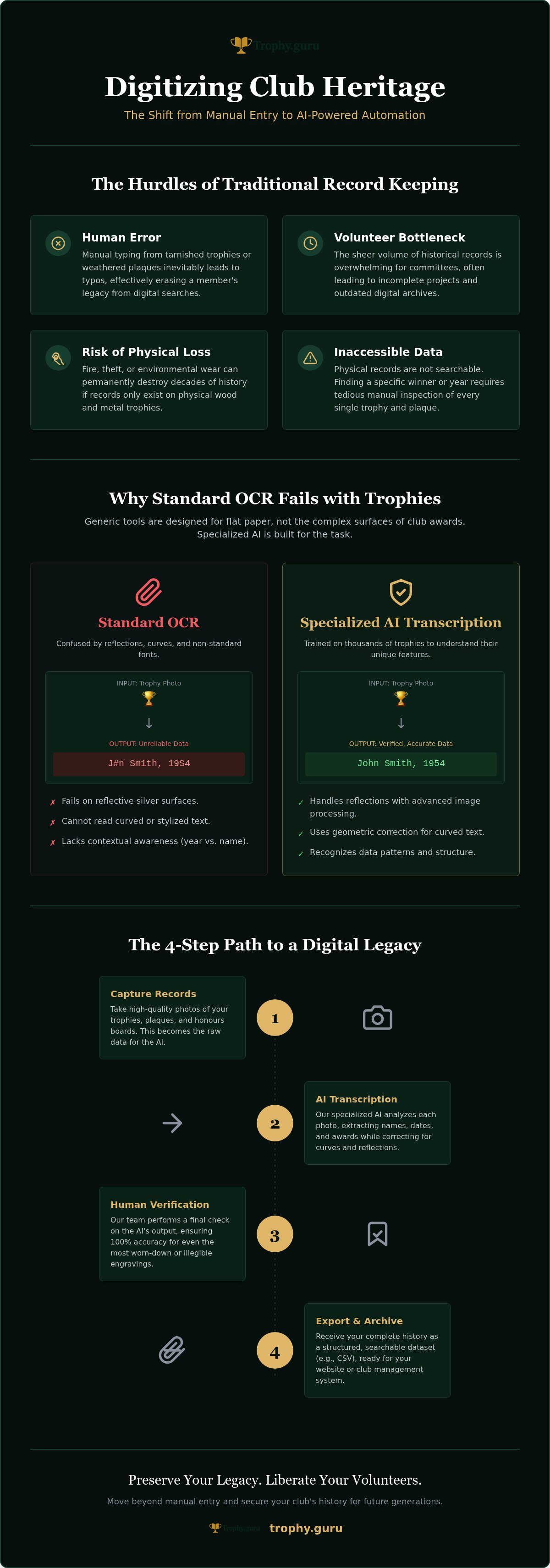
Traditional record-keeping relies heavily on the eyes and fingers of dedicated volunteers. This approach creates several critical points of failure. Human error is inevitable when transcribing names from weathered plaques or tarnished silver trophies; a single typo can effectively "delete" a member's legacy from a digital search. We also see a persistent volunteer bottleneck. Committees often have the ambition to digitize their history, but the sheer volume of work means records stop being updated. Beyond the time constraints, physical archives face the constant risk of loss. Fire, theft, or simple environmental wear can destroy decades of history in an instant if those records only exist on wood and metal.
Modern Automation Categories for Clubs
To build a resilient digital archive, clubs should look at automation across three distinct categories. Each serves a specific purpose in maintaining the integrity of the club’s data:
- Front-end automation: This involves online registration portals and digital forms that capture member data at the source, ensuring information is accurate from day one.
- Back-end automation: This is the recovery of historical data through AI-powered trophy engraving transcription services. These tools "read" photos of trophies to extract names and dates without manual typing.
- Reporting automation: Once data is captured, software can automatically generate CSV exports for league submissions or website updates, removing the need for double-handling information.
By implementing sports club data entry automation, committees can shift their focus from clerical tasks to community building. It is about moving away from the physical clutter of old ledgers and toward a streamlined, digital order that respects the past while serving the present.
Comparing Technologies: AI Transcription vs. Standard OCR
Standard Optical Character Recognition (OCR) was designed for flat, matte surfaces like scanned office documents. When applied to the diverse textures of a trophy cabinet, it quickly falters. Silver trophies present high-contrast reflections that act as visual obstacles, while wooden honours boards often feature non-standard layouts or faded gold leaf lettering. Effective sports club data entry automation requires a more sophisticated approach. Modern AI models utilize "contextual awareness" to understand the logic behind the data. Unlike basic OCR, which might see a series of shapes and guess a character, specialized AI recognizes structural patterns. It distinguishes between a four-digit year and a surname based on their spatial relationship on a plaque or shield.
Why Trophies Require Specialized AI
Physical awards are notoriously difficult to digitize because they are three-dimensional objects. Reflective surfaces create visual "noise" that confuses generic scanners, turning a clear name into a string of gibberish. Beyond these visual challenges, the curved text found on cups requires advanced geometric correction to flatten the image digitally before transcription can occur. If your club is struggling with these physical hurdles, you may find our guide on transcribing names from silver trophies particularly helpful. These technical nuances are why generic CRM tools often fail where purpose-built AI succeeds.
Data Integrity and Verification
Automation does not mean removing the human element entirely. It means augmenting it to preserve history with greater care. Even the most advanced sports club data entry automation must account for illegible or worn-down engravings that have survived decades of handling. A robust workflow includes a methodical verification step where a human-in-the-loop confirms the AI's findings. This process ensures 100% accuracy before the data is committed to a permanent digital archive. Once verified, the extracted metadata—names, years, and award titles—is transformed into an organized, searchable database. This digital order allows you to export CSV files or populate website honours boards in seconds. To see how this transition from physical clutter to digital order works, you can start with a free trophy transcription for your club.
Generic CRM vs. Specialized Transcription Services
Choosing the right tool for sports club data entry automation often leads committees to a difficult crossroads: do you adapt a general business platform or invest in a solution designed specifically for the task? Generic Customer Relationship Management (CRM) systems like monday.com or Salesforce are powerful, but they require significant "building" to manage physical archives. You must manually define data fields, create complex automation rules, and find external plugins to handle image processing. Specialized services like Trophy Guru are purpose-built for the heritage niche. They understand that a trophy is not just a data point; it's a piece of history that requires specific visual handling and metadata structure.
The investment of time and money also differs significantly between these two paths. Generic platforms usually demand ongoing monthly subscriptions that continue long after your initial data entry is complete. Specialized heritage tools often favor a "pay once" model for transcription, which aligns better with the finite budgets of amateur clubs. Implementation follows a similar pattern. A general CRM can take weeks of configuration and volunteer training to get right. A specialized service allows for instant photo uploads, moving from physical clutter to digital order in a single afternoon.
When to Use a General Club Management Tool
General tools are best suited for the daily pulse of club operations. If your primary goal is managing pitch bookings, tracking membership subscriptions, or coordinating team communications, a standard CRM is the logical choice. These platforms are excellent for the automation of recurring tasks like email reminders and payment chasing. While they are indispensable for managing the "now," they often lack the technical depth required for automatic trophy data entry. Use these for your operational workflow, but look toward specialized tools for your archival needs.
When Specialized Heritage Automation is Essential
Specialized sports club data entry automation becomes essential when the task involves decades of unrecorded history. If you are facing a backlog of 50 or more years of winners, manual entry into a generic spreadsheet is a recipe for volunteer burnout. These tools are critical in the following scenarios:
- When preparing for a club centenary or a major anniversary celebration.
- When you need to create a searchable digital honours board for your public website.
- When migrating data from fragmented, old Excel sheets into a unified, exportable CSV.
- When you need to ensure the longevity of records that currently only exist on weathered wood or tarnished silver.
By choosing a purpose-built service, you ensure that the transcription of names and years is handled with the reverence and technical accuracy your club’s history deserves.
How to Implement Data Entry Automation in Your Club
Moving from a physical backlog to a digital archive requires a methodical approach that respects the history of your organization. For club secretaries, the implementation of sports club data entry automation follows a clear Problem-Action-Result rhythm: you identify the stagnant physical backlog, capture the data through standardized photography, and finally generate a permanent digital archive. This structured workflow ensures that no name is left behind and no volunteer is overwhelmed by the transition from wood and silver to searchable data.
Step 1: The Heritage Audit
Before you touch a camera or a keyboard, you must understand the scope of your physical archives. Begin by auditing your clubrooms to count trophies, plaques, and old ledgers. Categorize these items by sport, era, and condition to build a clear roadmap for your digitization project. This audit often reveals "lost" records that only exist on physical plaques in a locked cabinet, which might otherwise be forgotten as committee members change over the years. By identifying these gaps, you can set firm priorities for which records to digitize first, ensuring your club's most significant achievements are protected from physical decay immediately.
Step 2: Capturing Clean Data
High-quality input leads to high-quality results. To ensure sports club data entry automation works effectively, you've got to standardize your photography process. Use diffused, natural lighting to minimize harsh reflections on silver or glass surfaces. Consistency is vital; adopt a simple naming convention for your photo files that matches the award category or decade. For detailed technical advice on setting up your shot, refer to our 2026 guide on photographing trophies. Capturing clean, sharp images significantly reduces the need for manual verification later.
Transcription and Long-Term Storage
Once your photos are organized, upload them to an automated transcription platform. The AI will extract names, years, and categories, creating a structured data set that mirrors your physical honours board. After a quick verification of the results, export the finalized data to a CSV file. This format provides long-term security for your records and allows you to easily display your history on a website or share it with league officials. It's a simple transition from physical clutter to digital order that secures your legacy for the next generation.
Ready to see how easily your records can be digitized? Get your first trophy transcribed for free and experience the accuracy of AI-driven automation today.
The Future of Club Records: Trophy Guru's AI Approach
Trophy Guru bridges the gap between traditional silver and modern digital archives. Our AI is specifically trained on the unique typography and layout styles common in engraving shops, from ornate Victorian scripts to modern sans-serif fonts. By focusing exclusively on this niche, we provide a level of accuracy that generic sports club data entry automation tools simply cannot match. This technology doesn't just read text; it understands the hierarchy of an honours board. The final result is a searchable, digital honours board that members can browse from their smartphones or home computers, ensuring the legacy of past champions remains visible and celebrated.
Moving Beyond the Spreadsheet
For decades, the standard digital solution was a shared Excel spreadsheet. However, Excel often becomes a digital dead end for club history. These files are frequently buried in old email threads or stored on a single volunteer’s personal laptop, creating dangerous data silos that vanish when a committee member moves on. A hosted digital archive offers far greater member engagement and accessibility. It transforms static, forgotten names into interactive records that can be filtered by year, sport, or specific award category. The system also supports high-quality CSV exports, which ensures future-proof record integrity. You aren't locked into a single platform; you own your data in a clean, structured format that will remain readable for decades.
Preserving the Past, Automating the Future
We believe that preserving history shouldn't come with a perpetual financial burden. Many modern club management suites demand ongoing monthly subscriptions that drain club funds year after year. In contrast, Trophy Guru operates on a flexible "pay only for what you need" model. You pay for the transcription of your physical backlog once, and the data is yours to keep. This approach respects the pragmatic financial needs of amateur organizations while providing professional-grade sports club data entry automation. It is a methodical transition from physical clutter to digital order that honors the past without taxing the future.
Getting started is a straightforward, risk-free process. We offer a free initial trophy transcription so you can witness the precision of our AI using your own club’s physical records. It's time to move your heritage out of the trophy cabinet and into a modern, accessible format. Modernise your club records with Trophy Guru today and ensure your club’s story is never lost to time.
Securing Your Club’s Legacy for the Next Generation
Transitioning from manual typing to AI-driven transcription is about more than just convenience; it's about protecting the names and years that define your club's history. You've seen how specialized AI overcomes the technical hurdles of reflective silver and complex board layouts with high precision. Moving beyond the digital dead end of fragmented spreadsheets allows you to create a searchable, hosted archive that members can access from anywhere. By implementing sports club data entry automation, you liberate your volunteers from clerical burdens and ensure no record is lost to physical decay or administrative turnover.
Our technology is already used by schools and sports clubs across the UK to deliver accuracy for reflective surfaces and weathered engravings. It's a methodical shift from physical clutter to digital order that honors the past while serving the future. Start your club's digital archive with a free trophy transcription and experience the transition for yourself. Protecting your heritage has never been more straightforward. We look forward to helping you preserve your club’s story for the next century.
Frequently Asked Questions
How accurate is AI at reading old trophy engravings?
Our AI is specifically trained on the unique typography found in engraving shops, which allows it to achieve high levels of accuracy even on weathered surfaces. It understands the context of historical records, distinguishing between names and years based on their position. While standard OCR often fails on curved or reflective silver, our specialized models are optimized to filter out visual noise and deliver precise transcriptions for your digital archive.
Can I export my automated club records to Excel or CSV?
You can export your finalized records into a structured CSV format at any time. This ensures that your club’s data remains portable and future-proof, allowing you to move beyond the limitations of "digital dead end" spreadsheets. These exports are ideal for uploading to club websites, sharing with league officials, or maintaining a secure offline backup. It is a simple way to maintain the integrity of your historical records.
Is automation expensive for a small local sports club?
Automation is highly accessible for small organizations because we use a "pay once" model rather than perpetual monthly subscriptions. This approach allows local committees to digitize their heritage within a fixed budget without worrying about ongoing software overheads. You only pay for the specific transcriptions you need. We also provide a free initial transcription so you can test the efficiency of the service before committing any club funds.
What happens if the AI can't read a particularly worn plaque?
When an engraving is exceptionally worn or damaged, our workflow includes a methodical verification step. While the AI does the heavy lifting, a human-in-the-loop can review and correct any ambiguous characters to ensure 100% data integrity. This hybrid approach guarantees that even the most challenging historical records are preserved accurately. It bridges the gap between raw machine processing and the meticulous nature of traditional archiving.
Do I need to be tech-savvy to use sports club data entry automation?
You don't need advanced technical skills to implement sports club data entry automation. The process is designed to be as simple as taking a clear photograph on your smartphone and uploading it to our platform. We handle the complex image processing and data extraction on our end. This allows club volunteers to focus on the noble task of preservation rather than struggling with complicated software configurations or manual typing.
How long does it take to transcribe an entire honours board using AI?
Transcribing a large honours board using AI takes a fraction of the time required for manual typing. Once you have captured and uploaded your standardized photographs, the system can process decades of winners in minutes. This eliminates the "volunteer bottleneck" that often stalls heritage projects for months. Instead of spending weeks at a keyboard, your committee can move from physical clutter to a digital archive in a single afternoon.
Can I use these automated records on our club's website?
Yes, the extracted data is perfectly suited for use on your club’s website. You can utilize our digital honours board hosting service to provide an interactive experience for your members or use the CSV export to populate your existing web pages. This makes your club’s history searchable and accessible to anyone with an internet connection, significantly increasing member engagement and celebrating the achievements of past and present champions.
Is my club's historical data secure in the cloud?
Your club’s historical records are stored in a secure cloud environment that provides a much higher level of protection than a single committee member’s laptop. Storing data centrally prevents the loss of information due to hardware failure or administrative turnover. By digitizing your physical records, you create a resilient backup that is safe from environmental damage, ensuring that your club’s heritage is preserved for the next generation of athletes.


