

Your club's expensive camera isn't the secret to a perfect digital archive; it's how you manage the light reflecting off a 1924 silver cup. Most club secretaries have felt the frustration of squinting at a blurry, glare-filled photo of an old honours board, wondering if a name is truly legible. Learning how to photograph trophies for transcription is the vital first step in moving from a cluttered physical cabinet to a searchable, digital legacy. It's a noble task that requires both a respect for history and a pragmatic approach to modern data management.
You already know that traditional photography often fails when faced with curved, polished surfaces and dim clubhouse lighting. This guide will help you master the technical skills required to turn reflective silverware and weathered boards into perfect digital records. We will show you how to eliminate distorting reflections, handle massive volumes of awards efficiently, and ensure your photos are ready for AI processing. By the end, you'll have a clear workflow to digitise your club's heritage with minimal manual entry and maximum accuracy.
Key Takeaways
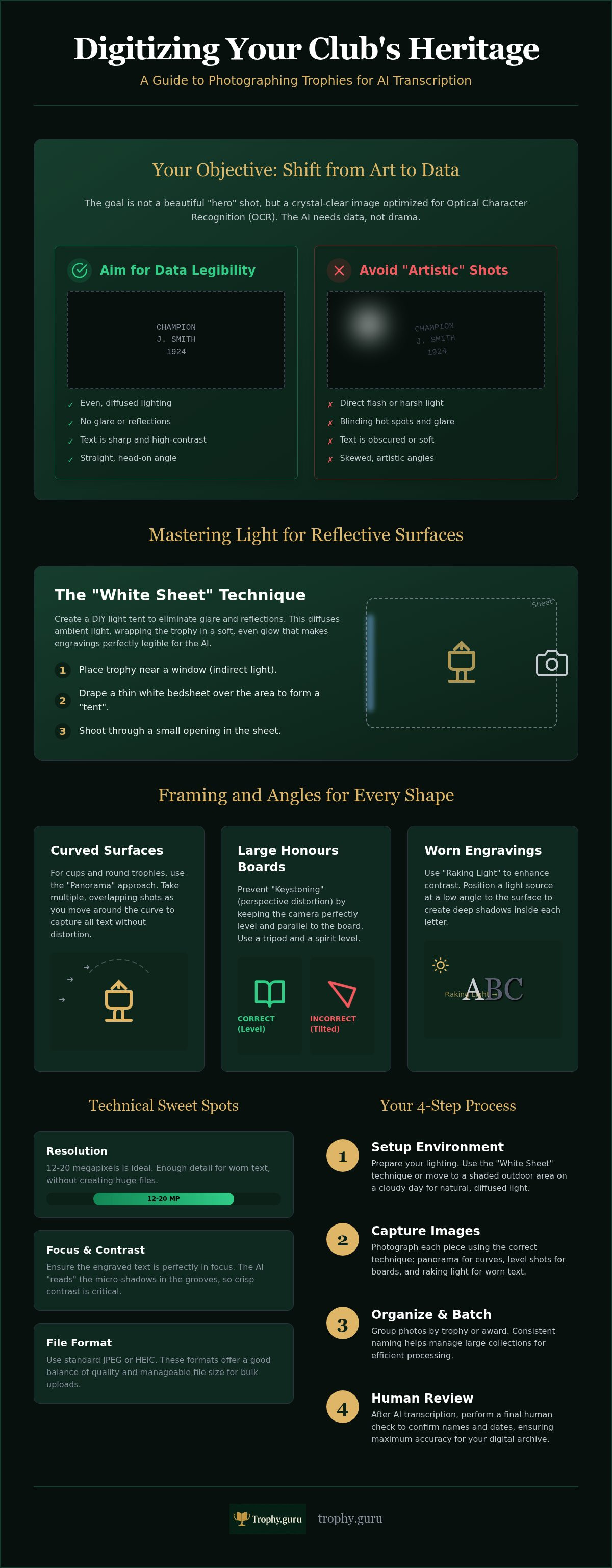
- Eliminate frustrating reflections on polished silverware by using the "White Sheet" technique to create soft, consistent light without a camera flash.
- Master the "Panorama" approach for curved surfaces to ensure you know exactly how to photograph trophies for transcription without losing names to distortion.
- Prevent "keystoning" on large honours boards by using a tripod and spirit level to maintain a perfectly level perspective for the AI.
- Shift your focus from artistic "hero" shots to optical clarity to help the transcription software achieve maximum accuracy for your digital records.
- Organise your collection efficiently through batch processing and a final human review to confirm the years and names captured from your club's history.
The Science of Image Quality and AI Transcription Accuracy
The transition from a physical trophy to a digital record relies on a specific technical bridge. While a professional photographer might aim for a "hero" shot that captures the majesty of a silver cup, those artistic images often fail the transcription process. The goal isn't beauty; it's data legibility. Understanding Optical Character Recognition (OCR) is the first step in mastering this process. Traditional OCR converts patterns of pixels into text, but modern AI transcription goes further by interpreting context and depth. When you are learning how to photograph trophies for transcription, you must prioritise optical clarity over aesthetic appeal.
Resolution plays a critical role when dealing with weathered engravings from the 1920s. Small, cramped text often softens after decades of polishing, making the edges of letters bleed into the surrounding metal. High-resolution sensors capture the minute variations in these worn surfaces, providing the AI with the granular data it needs to distinguish a "3" from an "8." By capturing the trophy from multiple angles, you enable multi-image analysis. This allows the software to compare different views of the same engraving, using the best parts of each frame to reconstruct a perfect digital record.
Contrast: The Key to Machine Readability
AI models don't actually see the metal of a trophy. Instead, they look for the micro-shadows cast within the engraved grooves. If your lighting is too "flat" or direct, it fills these shadows with light, rendering the text invisible to the software. To enhance readability on worn or shallow engravings, you need "raking light." This is light that hits the surface at an angle, creating deep shadows inside each letter. If the engraving looks like a faint ghost to your eyes, the AI will likely struggle to reconstruct the characters. Proper contrast ensures every character is crisp and distinct.
Resolution vs. File Size for Bulk Uploads
High resolution is essential for capturing fine details, but excessive file sizes can hinder the processing of large collections. Most modern smartphones are actually superior to older DSLRs for this task. Their internal processing automatically sharpens edges and balances exposure, which helps the transcription engine. A resolution of 12 to 20 megapixels is the "sweet spot." It provides enough detail for the AI to perform its analysis without creating massive files that slow down your archive project. Stick to standard JPEG or HEIC formats to maintain image integrity while keeping file sizes manageable for batch uploads.
Mastering Lighting for Reflective Silverware and Glass
Polished silver acts like a mirror, which is the primary obstacle for AI transcription. Direct light bounces off the surface, creating "hot spots" that mask engravings and confuse the software. To solve this, you must master how to photograph trophies for transcription by creating a diffused, shadow-controlled environment. The "Flash Trap" is your first enemy. Direct on-camera flash creates a blinding glare that makes text illegible for OCR software. Instead, rely on natural, indirect light to highlight the physical depth of the engraving.
Use the "White Sheet" technique to build a DIY light box. Drape a thin white bedsheet or muslin over a table near a window and place the trophy inside this fabric "tent." This setup distributes illumination evenly and helps you manage the "Photographer Reflection." By standing outside the fabric and shooting through a small gap, you avoid appearing on the trophy’s surface. This ensures the digital record remains focused on the heritage, not the person holding the camera.
Diffusing Light for Metal Surfaces
- Problem: Harsh artificial light creates specular highlights that hide text. Action: Tape baking paper over your lamps to act as a diffuser. Result: Soft light that wraps around the trophy without creating glare.
- Problem: Engravings look "flat" and invisible to AI. Action: Position lights at 45-degree angles to the trophy face. Result: Created "shadow depth" within the letters, making them stand out.
- Problem: Inconsistent lighting in club cabinets. Action: Move the collection to a shaded outdoor area on a cloudy day. Result: Naturally diffused light that aligns with the FADGI technical guidelines for archival imaging.
Specific Hacks for Etched Glass and Crystal
Glass trophies present a unique challenge due to their transparency. To make etched text "glow," use side-lighting and place a matte black card behind the trophy. This eliminates back-reflections and creates a high-contrast background. If you're struggling with persistent glare, a polarising filter can cut through reflections on glass surfaces. Mastering these lighting nuances is a critical part of how to photograph trophies for transcription effectively. Once you have captured these high-clarity images, you can start your free initial trophy transcription to verify the accuracy of your setup.
Framing and Angles: Managing Curved Surfaces and Deep Engravings
Capturing a flat honours board is a relatively straightforward task, but the three-dimensional geometry of a silver cup presents a unique challenge for digital archiving. When you are learning how to photograph trophies for transcription, you must account for the physical curve of the metal, which often causes text to wrap out of sight. A single front-on photo rarely captures the full list of winners. Instead, adopt a panorama approach. Take three to five vertical shots, rotating the trophy slightly between each frame to ensure every name is captured in the centre of the lens where distortion is at its lowest.
Perspective distortion is a common pitfall for the uninitiated. If you stand too close to a large cup, the centre bulges and the edges taper, making the text unreadable for AI models. Step back at least two metres and use your camera’s optical zoom. This technique flattens the image, maintains the correct proportions of the engravings, and ensures the AI can process the characters without having to correct for extreme fisheye effects. Always include the base, the lid, and any hallmarks in your sequence. These details help the system verify the age and provenance of the record, providing the context necessary for a complete digital history.
Overcoming the Curve with Multi-Image Analysis
Multi-image analysis is the backbone of accurate digital preservation for 3D objects. While you might seek one perfect shot, the transcription system actually benefits from five varied angles that provide a complete, wraparound view. The key is ensuring a 30% overlap between each photo. This overlap provides the necessary anchors for the AI to stitch the text together across the curved surface. Focus on the horizon line of the trophy, keeping the camera level to prevent the names from appearing to climb or dive across the frame as the AI reconstructs the data.
Capturing Close-ups of Individual Years
Many historic trophies feature small shields or plaques added to the base over several decades. These require a dedicated macro approach to ensure the text is crisp enough for extraction. Use a tripod to maintain a consistent distance between the lens and the base, which keeps the scale of the text uniform across the entire collection. When photographing these small elements, avoid getting so close that you block your own light source. Maintain enough space to allow your diffused lighting to reach the engraving, ensuring the AI can recognise the depth of each character clearly without being confused by shadows from the camera itself.
Capturing Large Honours Boards and Commemorative Plaques
Large honours boards are the backbone of many clubs, but their scale makes them difficult to capture. Unlike the curved silverware discussed earlier, these boards are flat, yet they present a distinct challenge: perspective distortion. When learning how to photograph trophies for transcription, achieving a perfectly square frame is non-negotiable. If the camera is tilted, the AI may misinterpret the distance between lines or the shape of letters. Using a tripod and a spirit level ensures your camera is parallel to the board, preventing "keystoning" where the top appears wider than the bottom.
Gold leaf on dark wood is a classic aesthetic, but it is a nightmare for transcription if the contrast is poor. Gold reflects light in every direction, often appearing as a bright white blob or a dark smudge depending on the angle. High contrast is vital. You need enough light to define the gold characters against the grain of the wood without washing them out. For boards that span several metres, a single photo is rarely sufficient. Adopt the "Tiling" method: break the board into a 3x3 grid. By taking nine high-resolution photos with slight overlaps, you provide the AI with the crisp, granular detail needed to digitise every name accurately.
Eliminating Perspective Distortion
Perspective is everything. To maintain the board's geometry, always shoot from the exact centre-point. If you stand to the side, the text on the far edge becomes compressed and unreadable. Most modern smartphones have a "Grid Lines" feature; use it to ensure the edges of the board are perfectly square within your frame. If you detect a minor tilt, correct it using a basic cropping tool before you start your AI trophy transcription. This simple preparation drastically reduces the need for manual data correction later.
Handling Varnish and Glare
Varnish acts like a mirror, reflecting every window and overhead bulb in the room. To combat this, use the "Off-Axis" lighting trick. Instead of placing lights behind the camera, move them to the sides at a shallow angle. This directs the reflection away from the lens while still illuminating the text. If you are stuck in a hallway with fixed lighting, hang a "Black-Out" cloth behind you to block distracting reflections. While matte boards are easier to process, these lighting techniques allow you to mimic that clarity on even the most high-gloss surfaces. This methodical approach ensures your club's history is preserved with the reverence it deserves.
Processing Your Collection: From Camera to Digital Archive
Once you've mastered how to photograph trophies for transcription, the focus shifts from the physical cabinet to the digital archive. This transition is where your technical effort converts into a permanent, searchable legacy for your club. Instead of the laborious process of manual data entry, which is often prone to human error and takes weeks of volunteer time, modern workflows use batch processing to handle hundreds of records in hours. Systematic organisation at the upload stage ensures that your digital honours board remains logical and easy to navigate for future generations.
Organise your files into logical sets before starting the upload. Grouping photos by trophy type or era allows the system to maintain context throughout the analysis. Once the images are processed, the "Human-in-the-Loop" review begins. This is a critical verification step where you confirm the AI’s proposed names and years against the original image. This collaborative approach between machine efficiency and human local knowledge guarantees 100% accuracy for your club’s historical records. Once verified, you can utilise the CSV Archive Export feature to secure your data in a format that your club owns and controls forever.
The Trophy Guru Workflow
The process is designed to be methodical and efficient. It follows a structured progression to ensure no detail is lost during the digitisation journey:
- Step 1: Upload. Submit your image sets, including silverware, honours boards, and result sheets, using the techniques discussed in previous sections.
- Step 2: Review. Verify the AI-extracted data. The system proposes years and names even from difficult sources, but your final check ensures total accuracy.
- Step 3: Publish. Create a searchable digital honours board. This allows members to browse the club's history by name, year, or award title online.
Preserving Heritage for the Future
Digital archives offer a level of security that physical trophies simply cannot match. Physical awards are vulnerable to fire, theft, or accidental loss during clubhouse renovations. By creating a digital record, you ensure that even if a silver cup goes missing, the achievement it represents is never forgotten. These searchable databases are also powerful tools for member engagement. They allow alumni and older members to rediscover their place in the club’s history from anywhere in the world. This transition from physical clutter to digital order is a noble task that protects the values of your organisation. You can start your first trophy transcription for free to see how quickly your physical history can become a secure digital asset.
Securing Your Club's Digital Legacy
Moving your club's history from a dusty cabinet to a searchable digital archive is a noble task that ensures every name is preserved for the future. By mastering how to photograph trophies for transcription, you've moved beyond simple snapshots and created a foundation for accurate data recovery. You now understand that controlling reflections with diffused light and using multi-angle framing are the keys to unlocking years of heritage. These techniques prevent distortion and ensure that even the most weathered engravings are captured with archival precision.
This methodical approach transitions your physical records into a secure, searchable database that members can browse from anywhere. Trusted by schools, golf clubs, and heritage collections, our system handles the heavy lifting of data extraction. You can digitise your club’s history with Trophy Guru - try one trophy free today. There is no credit card required for your first transcription, and the result is a professional digital honours board created automatically. It's time to protect your past with the precision of modern technology. Your club's history deserves to be more than just a memory; it deserves to be a permanent, searchable record.
Frequently Asked Questions
Can I just use my smartphone camera for trophy transcription?
Yes, you can use your smartphone camera, as modern devices are often superior to older DSLRs for this specific task. Their internal software automatically sharpens text and balances exposure, which helps the transcription engine. When learning how to photograph trophies for transcription, focus on keeping the lens clean and the camera steady. A resolution of 12 megapixels provides more than enough granular detail for the AI to extract names and years accurately from weathered surfaces.
What is the best lighting for shiny silver trophies?
The best lighting for shiny silver trophies is diffused, indirect light that eliminates harsh reflections. You should avoid using your camera’s built-in flash, as it creates "hot spots" that mask the engraving. Instead, use the "White Sheet" technique or photograph your collection outdoors on a cloudy day. This creates a soft, even glow that highlights the depth of the characters without creating the mirror-like glare that often confuses traditional OCR software.
How do I photograph a trophy with text all the way around it?
You should use a "Panorama" approach by taking three to five overlapping vertical shots to capture text that wraps around a cup. Ensure there is approximately 30% overlap between each image to allow the multi-image analysis software to stitch the data together. This methodical rotation ensures that every name appears in the centre of the frame where lens distortion is lowest. This technique is essential for creating a complete and accurate digital honours board.
My honours board is too big for one photo, what should I do?
You should break the board into a "tiled" grid of high-resolution photos if it is too large for a single frame. A 3x3 grid is usually sufficient for boards spanning several metres. Keep your camera perfectly parallel to the wood to avoid perspective distortion, often called "keystoning." Using a tripod and spirit level ensures the AI can maintain the correct geometry of the text across all nine images, resulting in a cleaner digital archive.
Can the AI read very old or faded engravings from the 19th century?
Yes, the AI is specifically designed to recognise and interpret weathered or shallow engravings from the 19th century. While these characters may look like faint ghosts to the human eye, the software looks for the micro-shadows cast within the grooves. To help the process, use raking light to deepen those shadows. Our age-aware matching system often proposes correct names and years even when the physical source has suffered from decades of polishing.
Do I need to clean the trophies before I photograph them?
You don't need to perform a deep polish, but removing surface dust with a soft cloth is highly recommended. Dust particles can catch the light and appear as punctuation or noise to the transcription engine. However, be careful not to create new swirl marks or scratches that might obscure the text. The goal is a clean surface that allows the engraving to stand out clearly against the metal or wood background.
What happens if the AI makes a mistake with a name?
You have the opportunity to verify and correct all data during the "Human-in-the-Loop" review stage. While the AI is highly accurate, it may occasionally misinterpret a worn character or an unusual name. The system presents its proposed transcription alongside your original photo for easy comparison. This ensures your club's digital records are 100% accurate before you publish them to your online honours board or export the data to a CSV file.
Is there a limit to how many photos I can upload for one trophy?
There is no strict limit to the number of photos you can upload, but three to five images per trophy is typically the ideal range. This provides enough data for multi-image analysis without creating unnecessarily large file sets that slow down your workflow. When you are mastering how to photograph trophies for transcription, remember that quality and overlap are more important than the sheer volume of photos. Focus on capturing every angle of the engraving clearly.

