

A clear photograph of an honours board doesn’t automatically make its history easy to search. Searchable honours board records depend on the details stored behind each image: consistent fields for a person’s name, award and year. Without them, finding a result can still mean scanning boards or piecing together scattered files.
If you’ve struggled with different spellings, abbreviated award names or years recorded in inconsistent formats, you’re not alone. Digitising the records is a useful first step, but consistent metadata helps people find and check the information later.
This article explains which details make honours board records more searchable and dependable, and how to organise them without creating unnecessary data-entry work. You’ll learn how consistent names, award titles and year formats support searches, verification and ongoing maintenance.
We’ll also look at how transcription can turn existing records into structured data, and how browsing and CSV export can make club history easier to explore and share. The aim is simple: preserve the record, make it easier to find, and keep it useful for future members.
Key Takeaways
- Learn why a digital image alone may not make honours board history easy to search.
- Choose consistent fields for searchable honours board records while preserving original wording for context.
- Compare paper lists, spreadsheets, searchable archives and displays by how easily records can be found and maintained.
- Follow a practical sequence to organise records, check details and keep the archive useful over time.
- See how AI-assisted transcription and CSV export can support an archive built from existing records.
What Makes Honours Board Records Searchable?
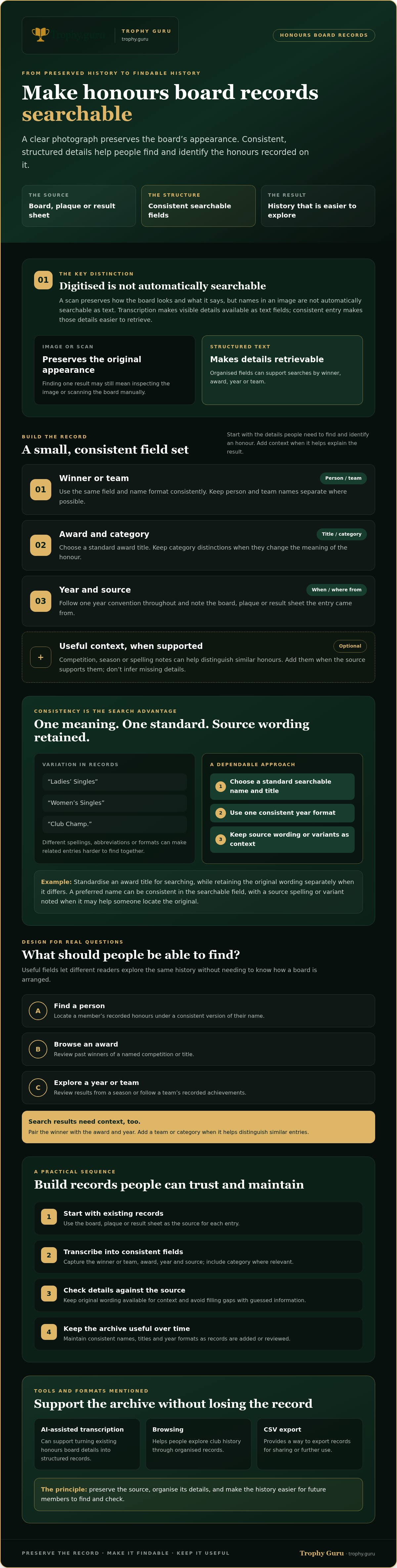
A searchable record is more than a name typed into a document. It’s an entry organised into consistent fields, so someone can retrieve it by a detail such as the winner, award, year or team. In short: searchable honours board records are entries with consistent, organised details that help people find and identify an honour without scanning every board.
These details are forms of metadata, or information that describes and organises a record. A name, award title and year describe what the entry records. Consistent formats help searches match the right details.
How searchable records differ from scanned honours boards
A photograph or scan preserves the board’s appearance and wording, but the names in the image aren’t automatically searchable as text. Someone may still need to inspect the image manually to locate a particular result.
Transcription turns visible information into text fields that can be searched. But the usefulness of a search depends on what was captured and how consistently it was entered. If one record says “Ladies’ Singles” and another says “Women’s Singles”, a search for one phrase may not find both unless the wording is standardised or the variation is recorded. Digitisation preserves the source; structured, consistent text makes its details retrievable.
What people need to find in an honours archive
Different readers approach the same history with different questions. A member might look for “Alex Morgan”; a coach may want every winner of the “Club Championship”; an archivist might need results from a particular year or team. Useful search fields support these searches without requiring people to know how the board is arranged.
Search results also need enough context to distinguish similar entries. A name alone may not show whether someone won a singles title or represented a team. Include the award and year alongside the winner, and add the team or category when it helps explain the result.
- Search by person: Find a member’s recorded honours, including entries under a consistent version of their name.
- Search by award: Browse past winners of a named competition or title.
- Search by year or team: Review results from a season or follow a team’s recorded achievements.
The goal isn’t to reduce history to bare search terms. Keep enough detail to understand each result, while giving names, awards and dates consistent fields that make the archive easier to explore.
Which Metadata Fields Make Honours Board Records Easier to Find?
A useful archive needs enough structure to answer common questions, but it doesn’t need to collect every detail about every winner. Essential fields make an honour searchable; optional context helps explain its history when the source supports it. Start with a small, consistent set, then add context where it helps people interpret a result.
Core fields for names, awards and years
Use clearly labelled fields for the winner or team, award, year, category and source. Keep person and team names separate where possible, so a search for a club side doesn’t get mixed with an individual winner. The source field can identify where the detail came from, such as a particular board, plaque or result sheet.
Consistency matters as much as choosing the fields. If an award appears as “Club Champion” in one entry and “Club Champ.” in another, a search may not group them as expected. Choose a standard award title, and preserve the source’s original wording separately if it differs. Apply one year convention throughout, such as recording the competition year as four digits. Don’t switch between a single year and a season range without a clear reason.
- Winner or team: Record the name in the same field and format each time.
- Award and category: Use consistent titles, keeping category distinctions where they affect meaning.
- Year and source: Follow one year convention and note the record the entry was transcribed from.
Metadata rules that prevent duplicate or missed results
Names can appear differently across older records. Decide how to handle initials, punctuation and known spelling variants. For example, keep the preferred searchable name consistent, while recording a source spelling or variant in a separate note when it may help someone locate the original. If a team changes its name, retain the name used for that result and add context only where it clarifies the change.
Optional fields can include competition, season or spelling notes. Add them when the evidence supports them and they help distinguish similar honours. Don’t infer a missing detail. Choose a clear value such as “unknown” or “not recorded” and use it consistently, rather than leaving a blank whose meaning is unclear.
If lettering is difficult to read, note the source and the uncertainty for later checking. A short review note is more useful than silently choosing a likely spelling. These conventions make searchable honours board records easier to maintain and help prevent avoidable duplicate entries.
Once your fields and conventions are clear, you can apply them as records are organised into a browsable archive. Explore Trophy Guru’s searchable archive as one option for keeping honours details together.
Spreadsheets, Searchable Archives and Digital Displays: What Should You Compare?
The right format depends on two separate needs: where the authoritative record is kept and how people access it. A touchscreen can make honours inviting to browse, but the display is only an interface. It doesn’t, by itself, explain how records are stored, checked, updated or exported.
Compare options by how records are retrieved and maintained, not by appearance alone:
- Paper lists and boards: Preserve a familiar record, but finding one result may mean scanning pages or plaques by eye. Updates can require changing the physical source.
- Spreadsheets: Offer a practical way to organise and filter a modest collection. Their usefulness depends on consistent entries, clear ownership and careful handling of edits.
- Searchable archives: Let people retrieve records using available fields. Check how administrators maintain entries and whether structured data can be exported.
- Touchscreen displays: Provide an interactive way to browse records. Assess the display separately from the archive or database that supplies its content.
Ask who can make changes, how those changes are checked, and whether members can browse without altering the source data. Also check what can be exported and in what format. These questions help keep searchable honours board records useful beyond the screen people see today.
When a spreadsheet is enough, and when search becomes difficult
A spreadsheet can work well when the collection is manageable and someone applies the same entry conventions consistently. It becomes harder to rely on as duplicate rows accumulate, award labels vary or several people edit the file without an agreed process. For practical spreadsheet approaches and alternatives, see Excel for Sports Club Records: Templates, Tips, and Modern Alternatives.
Plan for portability too. A structured export can help preserve a working archive or move its data into another tool. The guide to exporting club records to CSV covers that step in more detail.
What to check in an archive or display
Before choosing a system, test whether people can search the fields your organisation actually records, such as winner, team, award and year. Then consider the maintenance workflow: who is responsible for updates, how uncertain details are reviewed, and whether members can browse without changing source entries.
Consider the data store and its presentation as separate decisions. A polished display may help people explore club history, while clear administration and export options help keep the underlying records maintainable and portable.
How to Build Reliable Searchable Honours Board Records
A dependable archive is built in stages. Separate transcription from checking, then make ongoing maintenance part of the process. This helps preserve the original record while making its details easier to find and use.
From source material to structured entries
1. Inventory. List the records you have, such as honours boards, plaques, trophy engravings and result sheets. Note gaps or hard-to-read sources before deciding what to tackle first.
2. Capture. Transcribe names, years and award details, keeping the original image or a reference to its source alongside the entry where possible. For a wider view of the digitisation process, read the guide to digitising sports club award records.
3. Structure. Place details in consistent fields, but don’t erase historical wording. If a board uses an older award title, retain that wording as the source text and use a standardised title in the searchable field. This preserves the evidence while helping similar entries appear together in searches.
Check uncertain details, then maintain the archive
4. Check. Compare each transcription against the available source. Flag unclear letters, names or dates for follow-up instead of silently guessing. For instance, if an engraved character could be a “3” or an “8”, record that uncertainty and refer back to the source before treating the entry as confirmed.
5. Maintain. Assign responsibility for reviewing changes and adding new winners. Periodically check for duplicate entries, inconsistent award labels and missing fields. A regular review can catch small inconsistencies before they make records harder to retrieve.
Workflow in brief: Inventory and capture the source, structure the transcription, check uncertain details, then maintain the archive as records change. Transcription creates the entry; checking tests it against the evidence; maintenance keeps it useful.
Choose a workflow that fits your records
Before selecting a method, write down the questions members need answered: Can they find a person, award or winning year? Then assess the collection’s size, the condition of its sources, the administrator time available and whether you need an exportable copy. These practical needs should shape the workflow, not the appeal of a particular display or tool.
If you’re ready to test the transcription step, try one free initial trophy transcription and consider how its extracted details fit your checking and record-keeping process.
How Trophy Guru Can Turn Honours Board Details into Searchable Records
Once you’ve decided which details matter, the next step is turning existing records into structured entries. Trophy Guru uses AI-assisted transcription to extract names, years and other details from uploaded photographs of trophies, plaques or honours boards, as well as result sheets. The extracted details can be organised in a searchable online archive for people to browse.
This can help clubs bring scattered historical information into one place without manually typing every visible detail. The resulting searchable honours board records can also be exported as a CSV file, giving the organisation a structured copy of its archive data to keep or use elsewhere.
What the Trophy Guru workflow supports
Source quality matters. Clear, legible photographs or result sheets give transcription a better basis than an obscured image or unclear engraving, but AI-assisted extraction shouldn’t be treated as a guarantee that every detail is correct. Names, dates and award titles can be difficult to read, especially in older or worn records.
Keep the original source available and compare uncertain entries against it before relying on them. Consider whether the extracted details match the fields your organisation wants to search, such as winner, team, award and year. The archive supports browsing, while CSV export provides a way to take structured data beyond the browsing interface.
Decide whether this approach fits your records
Before uploading, consider the readability of your source material, the number of records you want to organise and the metadata fields your club has agreed to use. If sources vary in quality or wording, allow time to check transcriptions and preserve useful original details. Check the current terms for the free initial trophy transcription and any further processing before proceeding.
If this workflow suits your needs, explore Trophy Guru’s searchable archive workflow and try one trophy free. Starting with one source can help you assess how the material, extracted details and archive fit your record-keeping process.
Make Your Club’s History Easier to Explore
Good records do more than preserve past achievements. Consistent metadata helps people find a winner, award or year, while retaining source details makes entries easier to check and maintain. The right setup should also suit how your club updates its archive and shares information.
Building searchable honours board records doesn’t have to mean starting from scratch. Trophy Guru uses AI-assisted transcription to extract names, years and other details from uploaded record images, then brings them into a searchable archive for browsing. CSV export gives you a structured copy of the archive data to take elsewhere.
You can begin with one free initial trophy transcription. Check the current terms, then consider whether the source material and fields you want to capture are a good fit.
Try one trophy transcription free with Trophy Guru and take a practical first step towards making your club’s history easier to find, verify and share.
Frequently Asked Questions
What are searchable honours board records?
Searchable honours board records are structured entries that people can retrieve using details such as a winner’s name, award, year or team. Each entry needs consistent fields so searches can return relevant results rather than requiring someone to scan images or paper lists. A photograph preserves how a board looks; searchable text fields make its recorded achievements easier to find and identify.
Which metadata fields should an honours board record include?
Start with the winner or team, award title, year, category and source. Keep people and teams in separate fields where practical, and use the same format for names, award titles and dates throughout the archive. Add context such as competition, season or spelling notes when the source supports it and the detail helps distinguish an entry. Mark unknown information consistently instead of guessing.
Can scanned honours board images be searched by name?
Not automatically. A scanned image usually preserves the board as a picture, so a search tool may not recognise the names as text. To search by name, the visible information needs to be transcribed or processed with text recognition and captured in searchable fields. Results still depend on legibility, accurate transcription and consistent name formatting, so check uncertain readings against the original image.
How do you make old trophy and honours board records searchable?
Begin by gathering source material, such as board or plaque photographs, trophy images and result sheets. Capture the names, years and award details as structured entries, using consistent fields while retaining the original wording and a source reference. Check transcribed details against the material, flag unclear names or dates rather than guessing, then maintain the archive by reviewing new entries for duplicates and inconsistent labels.
What is the difference between a digital honours board and a searchable archive?
A digital honours board is the presentation people see when browsing achievements. A searchable archive is the underlying collection of structured records that lets users retrieve details by fields such as person, award or year. The two can work together, but they serve different purposes: a display presents history, while organised archive data supports search, checking, maintenance and, where available, export.
Can honours board records be exported to CSV?
Yes, if the archive or record system provides a CSV export option. CSV files store structured information in rows and columns, making them practical for keeping a copy or working with the data in compatible spreadsheet tools. Trophy Guru supports CSV archive export. Before relying on an export, check that the fields you need, such as names, award titles and years, are included and consistently populated.
How can clubs check AI-transcribed honours board records for errors?
Compare each transcription with its source photograph or result sheet, paying particular attention to names, dates and award titles. Flag ambiguous characters or incomplete details for follow-up instead of silently choosing a likely reading. Apply agreed conventions for spelling variants and award labels, then review entries for duplicates and missing fields. AI-assisted transcription can help extract information, but it shouldn’t replace checking against the original record.


