

What if the decades of history currently gathering dust in your school trophy cabinet could be brought to life with a single scan? You likely feel a deep responsibility to preserve the names and stories etched into those silver cups, yet the reality of managing them is often overwhelming. Physical honours boards are running out of wall space, and manual spreadsheets are notoriously prone to errors that compromise your school's heritage. Building a comprehensive trophy database for schools shouldn't feel like a chore that never ends. It's time to move beyond the limitations of physical storage and embrace a more permanent, accessible solution.
We understand that your school's history is its most valuable asset. This article explores the 2026 best practices for transforming physical records into a searchable digital legacy. You'll discover how modern AI transcription can accurately capture every name and date without hours of tedious typing. We'll also look at how digital hosting allows you to export clean data for yearbooks and ceremonies instantly. By the end of this guide, you'll have a clear roadmap to bridge the gap between tradition and technology, ensuring every student's achievement is preserved before the engravings fade away.
Key Takeaways
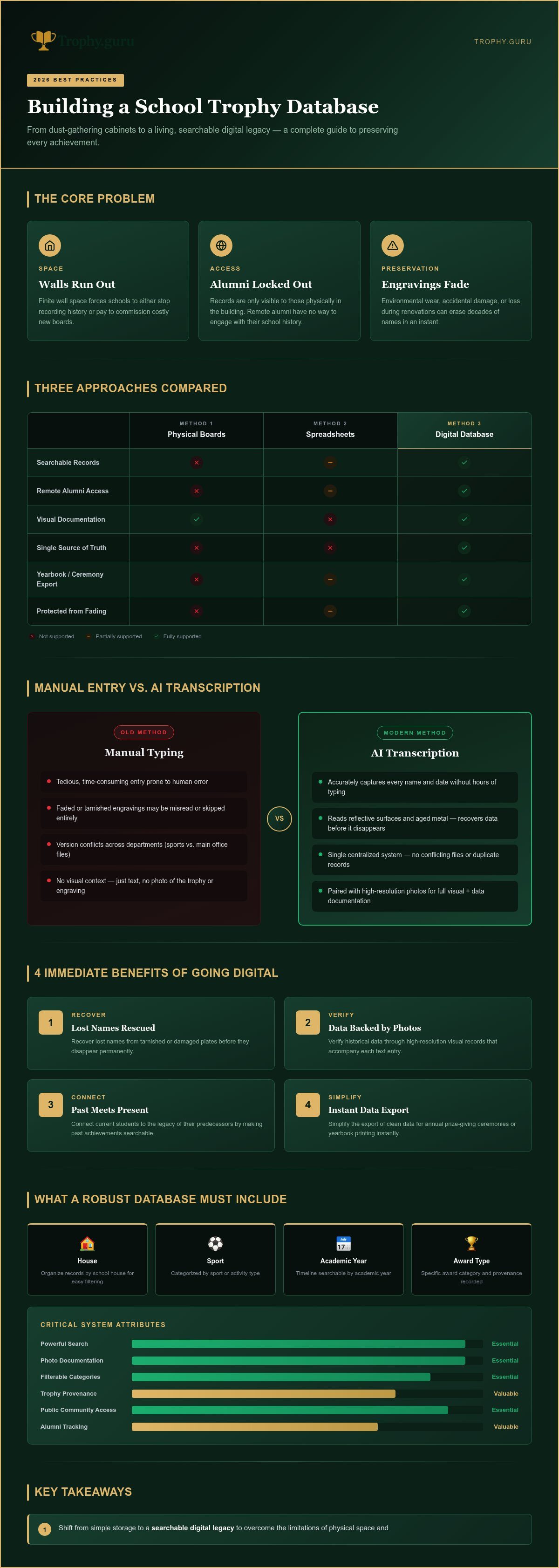
- Shift from simple storage to a searchable digital legacy to overcome the limitations of physical space and fading engravings.
- Implement a centralized trophy database for schools to create a permanent, error-free record of every historical achievement.
- Replace tedious manual typing with AI transcription that accurately recovers data from reflective surfaces and aged metal.
- Adopt standardized photography and audit steps to prepare your collection for a seamless digital transition.
- Use digital hosting and data portability to share your school's story with alumni while keeping your records ready for future ceremonies.
The Evolution of the School Trophy Database: Beyond the Cabinet
For generations, the school trophy cabinet has stood as a silent witness to student success. While we appreciate the history and significance of trophies as tangible rewards, the way schools manage the data behind these objects is changing. A modern trophy database for schools transforms these items from static display pieces into a living, searchable heritage. It isn't just about storage anymore. It's about accessibility. Physical engravings are fragile. They fade, tarnish, and eventually become unreadable. By digitizing these records, you ensure a win from 1974 remains as visible and celebrated as one from last week. This transition helps foster a deeper sense of school pride by making history available to everyone, not just those walking past a glass case.
The Limitations of Physical Honours Boards
Physical boards and cabinets face three primary challenges: space, access, and preservation. Most school halls have finite wall space. Once an honours board is full, schools face the costly task of commissioning a new one or stopping the record entirely. These boards are also only visible to people physically present in the building. Remote alumni, who often feel a strong sentimental connection to their school history, have no way to engage with these records from afar. Physical archives are vulnerable too. Environmental wear, accidental damage, or loss during renovations can erase decades of names in an instant. A digital approach removes these physical boundaries and safeguards the information forever.
Why Spreadsheets Aren’t Enough for Schools
Many administrators attempt to solve these issues with a basic spreadsheet. While better than nothing, spreadsheets often fail as a long-term trophy database for schools. Version control is a constant headache. The sports department might have one file while the main office has another, leading to conflicting records. Spreadsheets also lack visual context. They don't show the patina of the silver or the specific font of the engraving. Most importantly, they're difficult to share. A spreadsheet is a private document. A digital archive is a community asset. Moving to a dedicated platform allows for seamless sharing, ensuring the data is accurate, portable, and visually rich.
Transitioning to a digital system provides several immediate benefits for school heritage management:
- Recovering lost names from tarnished or damaged plates before they disappear.
- Verifying historical data through high-resolution visual records that accompany the text.
- Connecting current students to the legacy of their predecessors by making past achievements searchable.
- Simplifying the export of data for annual prize-giving ceremonies or yearbook printing.
What Defines a Robust Trophy Database for Schools?
A robust trophy database for schools is defined by its ability to turn raw data into a narrative. It's a centralized digital repository where every award name, year, and category is meticulously indexed. Unlike a simple inventory, a professional-grade database prioritizes high-quality visual documentation. Each entry should ideally include photographs of the trophy itself, capturing the specific texture of the engraving and the physical character of the award. This visual layer serves as an evidentiary record, proving the data's accuracy while preserving the aesthetic history of the school's achievements.
Accessibility is the ultimate metric for success. A database that remains locked behind an administrator's password doesn't serve the community. The system must feature powerful search functionality and filterable categories, allowing staff or alumni to find specific records in seconds. Whether it's a winner profile from the 1950s or a list of cricket captains across the decades, the information should be effortless to retrieve. A successful trophy database for schools acts as a bridge between the physical cabinet and the digital age, ensuring that no achievement is ever truly lost to time.
Essential Metadata for School Records
A high-functioning system relies on deep categorization. You should organize records by house, sport, academic year, and specific award type. It's equally vital to capture the provenance of the trophies. Who donated the cup? What was its original purpose? Recording these details preserves the human story behind the silver. By tagging winners accurately, you also create a valuable tool for alumni tracking, making it easier to invite former champions back for reunions or special events.
Integrating with Digital Honours Boards
Data is most powerful when it's visible. Once you have a secure backend, the next step is to bridge the gap to a public-facing display. You can learn how to digitize school trophy records to ensure they are ready for frontend hosting. This process allows the school to create interactive "Wall of Fame" displays in reception areas or school halls. These digital boards pull directly from your database, ensuring that any update made in the records is instantly reflected on the screens for students and visitors to see. To begin organizing your collection, you can use AI Trophy Transcription to convert your existing physical records into a clean, structured format.
Manual Entry vs. AI Transcription: Solving the Time Problem
The primary obstacle to building a comprehensive trophy database for schools isn't a lack of interest. It's time. Decades of engraved names representing a school’s legacy often sit trapped on physical objects because the task of transcribing them manually feels insurmountable. School administrators are already stretched thin. Asking a staff member to spend weeks hunched over a trophy cabinet with a notepad is rarely a viable option. This labor-intensive barrier is the reason many heritage projects never move past the planning stage.
The Burden of Manual Data Entry
Consider the scale of a typical school archive. If a school has 50 years of records across 100 trophies, each with 30 names, you're looking at 3,000 individual entries. Manual typing, including the time taken to decipher faded script and verify dates, can easily consume over 100 hours of staff time. This "overwhelm factor" is a significant drain on resources. Beyond the sheer duration, manual entry is notoriously prone to fatigue-related errors. A single transposed digit or a misspelled surname can compromise the accuracy of your historical records, making the database less reliable for alumni and future staff.
How AI Trophy Transcription Works
Modern technology offers a more efficient path. By using AI trophy transcription, schools can bypass the manual typing phase entirely. This technology is specifically designed to read text from challenging surfaces like reflective silver, tarnished brass, or dark wood. The workflow is intentionally simple. You upload a clear photo of the engraving, allow the machine learning algorithms to extract the text, and then perform a final verification before exporting the data. Machine learning is often more accurate than the human eye at deciphering stylized or worn fonts from the mid-20th century. This ensures your trophy database for schools is built on a foundation of verified facts. Automated services also provide a clear cost-benefit advantage. The expense of an automated transcription is significantly lower than the cumulative cost of dozens of administrative staff hours, allowing schools to preserve their heritage without straining their budgets. Starting with a free trial for a single trophy allows you to see the accuracy firsthand before committing to the full collection.
Best Practices for Setting Up Your School Archive
Setting up a trophy database for schools requires a methodical approach. It’s a project that demands both reverence for the past and technical precision. Before any digital work begins, conduct a thorough physical audit. Group your awards by house, sport, or academic department. This initial organization prevents data duplication later. It’s also the ideal time to identify trophies with damaged or heavily faded engravings that might require extra attention during the digitization process.
Photographing Trophies for the Database
High-quality images are the foundation of accurate data extraction. Reflections on silver or gold plating often obscure text, making it difficult for automated systems to read. Use diffused lighting or a matte backdrop to minimize glare. Ensure every engraving is clearly visible and legible. Organize your image files into folders by department as you go. This saves hours of sorting time during the upload phase. Remember that the AI system relies on these visual cues to distinguish between names and dates correctly.
Consistency is paramount. Establish a strict naming convention for your categories early on. For example, decide if "U15 Cricket" will always be recorded as "Under 15 Cricket" or "U15 Cricket." Once the data is extracted, establish a verification process. Cross-referencing AI-generated lists with historical school magazines or yearbooks ensures the digital record is a true reflection of the school's heritage. This step builds trust in the new digital system among staff and alumni.
Data Portability and Exports
A robust system must offer flexible data portability. Ensuring your database supports CSV and PDF exports is essential for long-term utility. These exports allow you to generate clean lists for annual prize-giving ceremonies or create content for alumni newsletters. This portability transforms a static archive into a functional tool for school administration. It also ensures you aren't locked into a single platform, keeping your school’s history portable and secure.
Plan for the future. A successful archive isn't a one-off project; it’s a living record. Schedule an annual update immediately following your final awards ceremony of the year. This ensures your trophy database for schools remains current and continues to grow with each new generation of students. To start your digitization journey with professional accuracy, you can get started with AI Trophy Transcription today.
Future-Proofing Your School Heritage with Trophy Guru
Trophy Guru serves as the bridge between physical clutter and digital order. We specialize in the unique needs of school and heritage collections. These aren't just lists. They are legacies. By implementing a dedicated trophy database for schools, you ensure every student's effort remains part of the institution's ongoing narrative. Our approach combines the meticulous nature of a traditional historian with the efficiency of modern technology. We help you transition from overflowing cabinets to structured, searchable records that stand the test of time.
A central part of this preservation is the presentation. Creating a permanent digital honours board for sports clubs and schools allows you to showcase history without the constraints of physical wall space. We understand that school budgets require predictability. That's why we utilize a "Pay Once" model for our services. This provides a budget-friendly way to secure your school's heritage without worrying about recurring fees for your data. Your records remain yours, forever.
A Searchable Legacy for Future Students
A digital archive does more than store names; it builds community. When history is accessible on tablets or interactive hall displays, current students see the path paved by those before them. They can search for family members, house captains, or record holders. This turns a dusty trophy into a source of inspiration. Accessibility bridges the generational gap. It connects alumni with the modern school environment through shared achievements. History becomes a living asset rather than a forgotten box in a corridor.
Next Steps for School Administrators
Starting a full-scale digitization project doesn't have to happen all at once. We recommend beginning with a single department or a specific sport. This allows you to see the immediate impact of a trophy database for schools without overwhelming your staff. You can request a demonstration of the AI transcription service to see how the technology handles your specific collection. To experience the accuracy firsthand, you can start your school trophy database with a free transcription today. We provide the tools to recover and organize your history, ensuring it remains as vibrant as the day it was first earned.
Securing Your School's Legacy for the Next Generation
Preserving school history is no longer a matter of finding more wall space or managing error-prone spreadsheets. By implementing a modern trophy database for schools, you transform physical objects into a permanent digital asset. You've seen how AI transcription removes the burden of manual typing and why standardized photography ensures every name is captured with precision. This shift doesn't just organize your records; it creates a living archive that students and alumni can access from anywhere in the world.
It's time to bridge the gap between your school's past and its digital future. Our AI-powered transcription offers 99% accuracy on engravings, ensuring your records are both reliable and professional. You can also host searchable digital honours boards to engage your wider community and celebrate every achievement. We invite you to digitize your school trophies with Trophy Guru today. You can even have your first trophy transcribed for free to experience the accuracy and ease of the service firsthand. Your school's heritage is too valuable to leave to chance. Start building your digital legacy now.
Frequently Asked Questions
How do I start a trophy database for a school with 100+ years of history?
You start by conducting a systematic physical audit of your current collection to organize items by department or house. For schools with over a century of records, the volume of data can be daunting. We recommend using AI Trophy Transcription to process the engravings from photographs rather than typing names manually. This approach allows you to build a comprehensive trophy database for schools without exhausting your administrative staff's time or resources.
Can AI accurately read old or worn engravings on silver trophies?
Yes, modern AI transcription technology is specifically trained to decipher text from challenging surfaces like reflective silver and tarnished brass. While human eyes might struggle with stylized script or worn lettering from the mid-20th century, machine learning algorithms can often identify patterns more accurately. To ensure the best results, you should provide high-resolution images taken in diffused lighting. This helps the system extract every name and date with professional precision.
Is it better to use Excel or a dedicated trophy database system?
A dedicated system is significantly more effective than Excel because it provides visual context and community accessibility. While spreadsheets are useful for basic lists, they often lack the ability to store photos of the awards or allow for easy alumni browsing. A professional trophy database for schools ensures version control across departments and offers a more engaging way to showcase your school's heritage. It's a living archive rather than just a static file.
How much does it cost to digitize a school trophy collection?
Digitizing a collection follows a transactional "Pay Once" model rather than a recurring subscription. We offer a free trial that includes the transcription of one trophy so you can verify the accuracy for yourself. For larger collections, you pay based on the volume of records you need to process. This transparent approach allows school administrators to plan their heritage projects within a fixed budget without worrying about ongoing maintenance fees or hidden costs.
Can we export school trophy data to use in our annual yearbook?
Data can be exported into portable formats like CSV files for use in various school publications. This functionality is essential for administrators who need to generate accurate lists for annual prize-giving ceremonies or yearbook layouts. By having your records in a structured digital format, you eliminate the risk of spelling errors or missing entries. It's a simple way to ensure your school's printed history is as accurate as your digital archive.
Do we need special equipment to photograph trophies for transcription?
Special equipment isn't necessary; a modern smartphone camera is usually sufficient for high-quality results. The most important factor is managing reflections on metallic surfaces by using diffused, natural light and a simple matte backdrop. You should focus on capturing the engraving clearly and ensuring the text is legible in the frame. These simple steps allow the AI system to process your school's records with the highest possible level of accuracy.
How do we handle trophies that are missing or have been lost over time?
Missing items can be documented by using historical school magazines, yearbooks, or honours boards to fill in the gaps. A digital database allows you to create records based on textual evidence even if the physical trophy is no longer in the school's possession. This ensures your institutional memory remains complete. By documenting these lost items alongside your current collection, you preserve a full narrative of student achievement that isn't limited by physical inventory.
Who should manage the school trophy database on an ongoing basis?
The ongoing management is best handled by a designated sports administrator, school archivist, or an alumni association lead. Because the system is designed for ease of use, it doesn't require advanced technical skills to maintain. We recommend scheduling an annual update immediately after your final awards ceremony. This keeps the records current and ensures that every new winner is added to the school's digital legacy while the information is still fresh and easily verified.


