

Did you know that over 70% of century-old sports clubs have officially run out of wall space for traditional honours boards? It's a silent crisis for many committees. You're likely facing the same dilemma: your physical boards are full, the older engravings are becoming impossible to read, and the thought of manually typing decades of names into a spreadsheet feels like an endless chore. You value your club's heritage deeply, but it's hard to inspire the next generation when your history is locked behind the dusty glass of a trophy cabinet that members rarely glance at anymore.
This guide provides a clear, methodical path to transforming those records into a sleek, searchable interactive club history display. You'll discover how to leverage modern tools like AI Trophy Transcription to digitize your records with precision and speed. We'll walk through the essential steps of selecting commercial-grade hardware, ensuring ADA compliance for accessibility, and creating a database that's as easy to update as it is to browse. By the end, you'll have a roadmap to build a digital archive that doesn't just store names, but actively celebrates the people who built your club.
Key Takeaways
- Learn why moving beyond physical wall limits is essential for clubs that have run out of room for new honours boards.
- Understand the hardware requirements for your interactive club history display, ranging from versatile tablets to professional-grade kiosk systems.
- Discover how AI Trophy Transcription eliminates the need for manual typing, converting complex engravings into a searchable digital format in minutes.
- Master a simple four-step implementation process to audit your physical collection and successfully launch your digital archive.
- Explore how to future-proof your records using CSV exports, ensuring your heritage remains accessible and easy to update every season.
The Evolution of Heritage: Why Switch to an Interactive Club History Display?
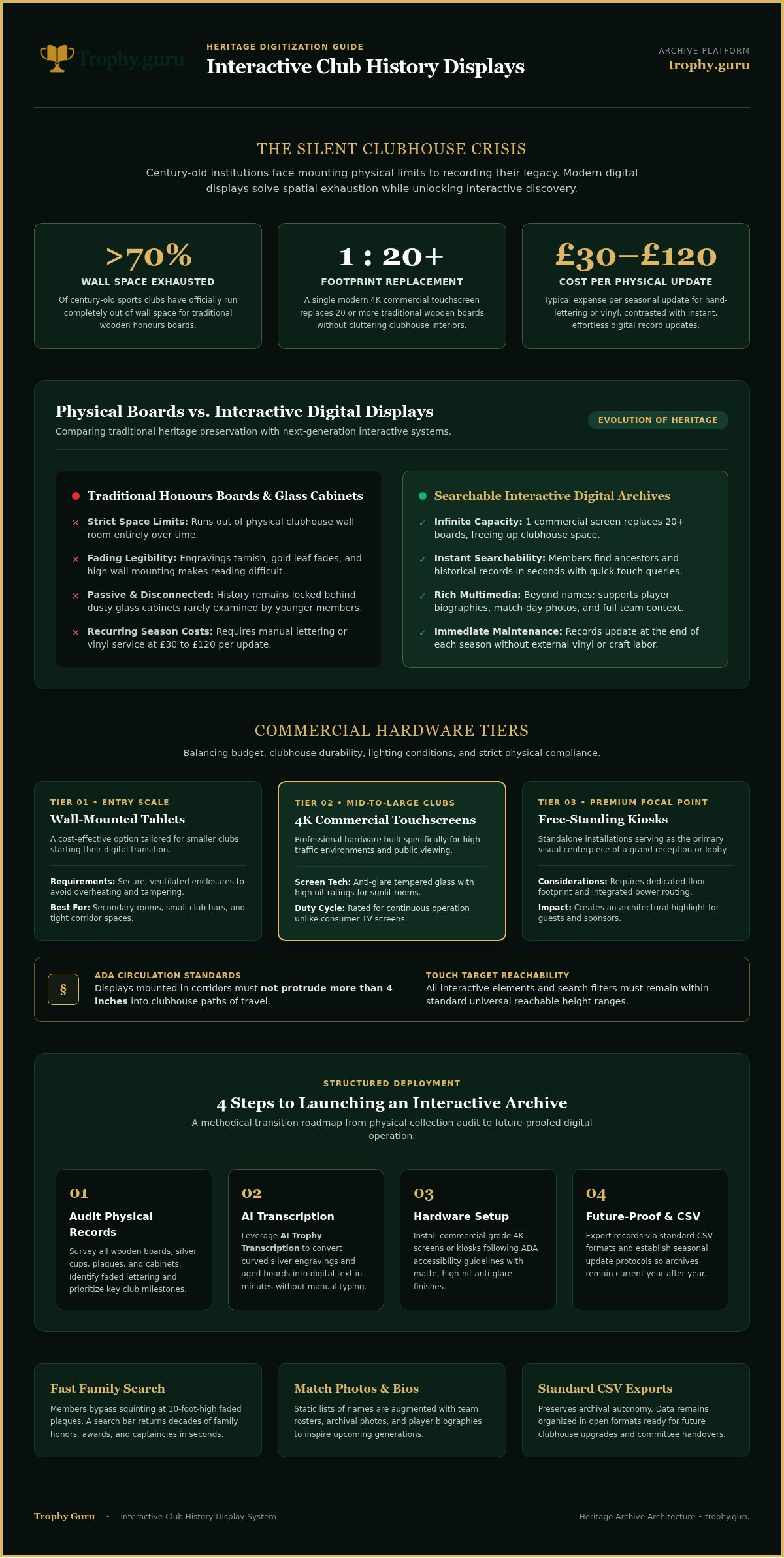
An interactive club history display serves as a sophisticated digital portal, centralizing decades of achievement into a single, accessible point of engagement. For many organizations, the transition isn't just about modernizing the lobby; it's a response to a looming physical crisis. Research shows that over 70% of century-old sports clubs have officially run out of wall space for traditional wooden honours boards. When every square inch of the clubhouse is covered in plaques, the history of the club effectively stops being recorded unless you find a more efficient solution.
Digital records provide a level of permanence and utility that physical silver and wood simply can't offer. While engravings tarnish and gold leaf fades over time, a digital archive remains sharp and legible forever. The most significant benefit, however, is searchability. Instead of forcing members to squint at a fading board mounted high on a wall, a digital system allows them to find their family history in seconds. It turns a static list of names into a searchable database where every member can find their own legacy with a few taps.
Breaking the 'Dusty Cabinet' Stereotype
Traditional trophy cabinets often feel like static museums where stories are trapped behind glass. By utilizing interactive kiosk systems, you invite members to engage with the narrative directly. Younger club members, who expect digital accessibility, find this format far more compelling than a passive display. Instead of just reading a name and a year, they can tap a record to view match-day photos or read detailed player bios. This moves the experience from passive viewing to active discovery, ensuring the club's history feels relevant to every generation.
Space Efficiency and Modern Clubhouse Aesthetics
The visual impact of your clubhouse influences how sponsors and visitors perceive the organization. A single 4K touchscreen can replace twenty or more wooden boards, creating a clean, professional aesthetic that complements modern interior design. This efficiency solves the "wall space crisis" while offering incredible flexibility. Maintaining traditional boards is expensive, often costing between £30 and £120 per update for hand-lettering or vinyl work. A digital display allows you to update records instantly at the end of every season, ensuring your honours boards are always current and your walls remain uncluttered.
Essential Components: Hardware and Software for Your Digital Archive
Building an effective interactive club history display requires a careful balance between durable hardware and flexible software. You don't need a museum-sized budget to succeed, but you do need components that can withstand the unique environment of a clubhouse. From high-traffic hallways to sunlit bars, the choices you make during the planning phase will determine the longevity of your digital archive. It's about creating a system that is as resilient as the history it preserves.
Choosing the Right Screen for Your Space
Hardware selection typically falls into three tiers based on scale and budget. Smaller clubs often begin with wall-mounted tablets. These are cost-effective but require secure, ventilated enclosures to prevent tampering. Mid-to-large organizations usually opt for professional-grade 4K commercial touchscreens. Unlike consumer TVs, these screens feature anti-glare tempered glass and are rated for continuous operation. For a premium feel, free-standing interactive kiosks provide a dedicated focal point in a lobby, though they require more floor space and specific power considerations.
When positioning your display, consider environmental factors like brightness and glare. Clubhouse windows can wash out standard screens, so look for displays with high nit ratings and matte finishes. Durability is equally vital. In high-traffic areas, screens should be mounted following ADA standards, ensuring touch targets remain reachable for all members while not protruding more than 4 inches into circulation paths. Following established archival digitization guidelines ensures that your hardware choices support the long-term accessibility of your records.
Software: The Engine Behind the Interface
The software is what turns a static screen into a dynamic experience. While some clubs attempt bespoke app development, most find success with web-based honours boards. These systems are easier to maintain and allow members to access the archive from their own smartphones via QR codes. A robust database backend is essential for searchability; it allows a user to type a name and instantly see every award that person has won over the last fifty years. You can compare the latest options in our guide to the best digital honours boards for sports clubs.
Reliability is non-negotiable for public-facing displays. Your system must use a 'Kiosk Mode' to lock down the interface, preventing users from exiting the archive or tampering with system settings. Additionally, while cloud-based hosting is standard, ensure your software supports offline caching. This prevents the screen from going blank if the clubhouse Wi-Fi flickers during a busy event. If you're ready to start organizing your data for such a system, you can explore how AI handles the heavy lifting of record transcription.
The Data Challenge: Converting Physical Trophies into Interactive Content
The single most significant hurdle in launching an interactive club history display isn't the hardware or the mounting. It's the data. Transcribing decades of names from curved silver surfaces and faded wooden boards is a daunting task that often stalls digitization projects before they begin. While some organizations attempt to use volunteers for manual entry, this method is notoriously slow and prone to high error rates. Deciphering 50 years of hand-engraved names requires a level of precision that manual typing rarely achieves over long sessions.
Estimates suggest that manual spreadsheet entry can take between 20 and 30 minutes per trophy when you account for deciphering script, cross-referencing member rolls, and correcting typos. For a club with 100 trophies, that's 50 hours of tedious labor. Moving from physical silver to a digital record is the most critical step in your journey, and it requires a methodical approach to ensure the accuracy of your heritage.
AI Trophy Transcription: A Modern Solution
Modern technology has simplified the recovery of these records. AI Trophy Transcription uses specialized computer vision models to extract text from reflective and curved surfaces that standard scanners can't read. Instead of typing for months, your committee can photograph the entire collection in a single afternoon. The AI processes multiple angles to overcome the "mirror effect" of polished silver, often achieving accuracy scores exceeding 95%. This transition from physical clutter to digital order happens in minutes, not weeks, significantly reducing the administrative burden on your staff.
The Importance of Searchable Metadata
A simple photo or a PDF scan of an old honours board isn't enough for a modern archive. To be truly interactive, your data needs structured metadata, including the year, the award category, and the winner's name. This structure is what allows a member to type their surname into a touchscreen and instantly see every trophy they've won across different decades. It turns a static list into a dynamic web of connections. For practical advice on structuring these files, read our guide on how to modernise your club heritage.
By pairing high-resolution imagery with verified text, you create a "digital twin" of your physical collection. This ensures that even if a trophy is lost or a wooden board reaches its physical wall limit, the legacy remains intact within your space-saving digital exhibitions. Members don't just see a name on a list; they see the actual award their predecessors held, preserved in a format that will never tarnish or fade.
Implementation Guide: 4 Steps to Launching Your Interactive Display
Transitioning from a physical collection to a digital platform is a sequential process that requires meticulous planning. By following a structured roadmap, you can ensure that no record is left behind and that the final interactive club history display serves as a reliable source of truth for your members. This implementation phase bridges the gap between your physical heritage and its new digital home.
- Step 1: The Audit. Begin by documenting every item in your collection. This involves photographing every trophy, plaque, and honours board from multiple angles to ensure all text is captured clearly.
- Step 2: Digitization. Upload your high-resolution images to a platform that utilizes AI Trophy Transcription. This converts your visual records into a structured CSV archive, providing the searchable data engine for your display.
- Step 3: Design. Select a digital honours board template that reflects your club’s branding. The goal is to create an interface that is both visually respectful of your traditions and easy to navigate.
- Step 4: Deployment. Install your hardware, configure the kiosk software, and launch the 'Virtual Trophy Room'. This allows members to access the archive both in the clubhouse and via their mobile devices.
Audit and Photography Best Practices
The quality of your digital archive depends entirely on the clarity of your source images. When photographing silver trophies, use diffuse lighting to minimize specular reflections. Glare is the primary enemy of data accuracy; positioning a simple white sheet opposite your light source can soften shadows and make engravings more legible for AI processing. Organize your files immediately by category, such as Junior, Senior, or Special Awards, to streamline the upload process. For a comprehensive list of equipment and techniques, consult our guide on how to digitise old honours boards.
Designing for Member Engagement
A successful interactive club history display must be intuitive for users of all ages. Large touch targets and high-contrast text are essential for older members who may find smaller fonts challenging. To increase engagement, don't just list names. Include 'Member Spotlights' or scanned historical photos alongside individual records to provide context. Integrating a 'Virtual Trophy Room' element ensures that your history is accessible to remote members or those researching family history from home, turning your clubhouse records into a global resource.
If you're ready to move from the planning phase to action, you can start your digitization project today by testing our transcription tools on your most challenging trophy.
Future-Proofing Your Legacy: Integrating Trophy Guru’s Digital Honours Board
Creating a permanent record for your organization requires a system that outlasts current hardware trends. Trophy Guru functions as a scalable backend for clubs of all sizes, acting as the centralized repository for your historical data. Unlike many digital signage solutions that lock committees into expensive, recurring monthly subscriptions, this platform focuses on a transparent one-time fee model. This approach respects club budgets while ensuring your records remain accessible without the threat of a service cutoff due to lapsed payments.
To reduce entry friction, the system offers a Free Initial Trophy transcription. This allows committee members to pilot the technology risk-free, verifying the accuracy of the AI Trophy Transcription on their most complex silverware before committing to a full audit. It's a pragmatic first step toward building a truly comprehensive archive. By starting with a single item, you can demonstrate the value of a digital system to your board without any upfront financial commitment.
Seamless Data Management with CSV Exports
Data integrity is the foundation of any long-term heritage project. One of the most significant advantages of using this platform is the CSV Archive Export functionality. If your club decides to build a custom kiosk or use specific third-party display software, you aren't tethered to a single provider. You can export your verified names, years, and categories into a standard spreadsheet format at any time. This ensures you maintain full ownership of your data regardless of how display technology evolves.
This flexibility simplifies the handover process for future club committees. Instead of passing down a box of loose papers or a password-locked proprietary app, you provide a clean, structured database. Updating records annually becomes a simple task of adding new rows to a CSV, ensuring your interactive club history display remains current with minimal administrative effort. It turns a once-daunting task into a manageable seasonal update.
Engaging the Community Beyond the Clubhouse
Your heritage shouldn't be confined to the physical walls of the clubhouse. By hosting your records digitally, you can share your interactive club history display via your club website and social media channels. This transparency fosters a deeper connection with your members, especially those who can no longer visit the premises regularly. It transforms your history from a static wall into a living, breathing community asset.
Utilizing a virtual trophy room is particularly effective for connecting with alumni and distant family members of past winners. It turns your private records into a public-facing celebration of achievement that can be accessed from anywhere in the world. When you are ready to begin, start your digitization journey with a free trophy transcription and see how easily your physical past becomes a digital future.
Securing Your Club’s Legacy for the Next Generation
Your club's history is more than a collection of names; it's the foundation of your community's identity. Moving toward an interactive club history display ensures those stories are no longer confined to fading boards or crowded cabinets. By prioritizing accurate data collection through AI and selecting hardware that meets modern accessibility standards, you create a living archive that resonates with every generation.
The transition from physical clutter to digital order doesn't have to be overwhelming. With searchable cloud-based archives and the flexibility of a one-time transcription fee, you can build a system that is as easy to maintain as it is to browse. It's about protecting your past while making room for the winners of the future. Success lies in starting small and using the right tools to ensure data integrity for years to come.
Take the first step in this essential task without any initial cost. Start digitising your club history with your first free trophy today at Trophy Guru and experience the accuracy of our AI-powered transcription firsthand. Your legacy deserves to be seen, searched, and celebrated for decades to come.
Frequently Asked Questions
What is the best screen size for an interactive club history display?
The ideal screen size for an interactive club history display typically ranges between 43 and 55 inches for a main clubhouse foyer. This size ensures that text remains legible from a distance while providing enough touch surface for multiple users. Smaller 10-inch tablets are better suited for individual bar tables or narrow corridors. Always select a commercial-grade screen with an anti-glare finish to combat bright clubhouse lighting and ensure a professional appearance.
How do I digitise old wooden honours boards with hundreds of names?
You can digitise old wooden honours boards by taking high-resolution photographs of each section and processing them through AI Trophy Transcription. This technology identifies names and years even from faded gold leaf or hand-painted script. Once the AI extracts the data, you can verify the records in a digital archive. This method is significantly faster than manual typing and preserves a visual "digital twin" of the original board for your records.
Can I use an iPad as an interactive trophy display?
Yes, an iPad is an excellent choice for smaller interactive trophy displays or as a secondary search station. You should mount it in a secure, ventilated wall enclosure to prevent theft and overheating. While tablets are cost-effective and familiar to users, they lack the high-impact presence of a 55-inch commercial touchscreen. For the best results, ensure the iPad is locked into a dedicated kiosk mode to maintain the focus on your heritage.
How often should a digital honours board be updated?
Most clubs find that updating their digital honours board once per season is the most efficient approach. This coincides with annual awards nights and ensures that the latest winners are celebrated while the achievements are still fresh. Because digital systems allow for instant updates, you don't have to wait for a signwriter to visit the premises. You simply upload a photo of the new engraving and sync the record to your display.
Do I need an internet connection for my clubhouse display to work?
A stable internet connection is recommended for initial setup and seasonal updates, but it isn't strictly necessary for daily operation. Many modern systems use offline caching, which stores the display data locally on the media player. This ensures the screen remains functional even if the clubhouse Wi-Fi drops out. However, you will need a connection to sync new records or to allow members to access the archive via QR codes on their smartphones.
What is the cost of converting physical trophies to a digital database?
The cost depends on the size of your collection and the level of automation you choose. Trophy Guru uses a transparent payment model where you pay a one-time transcription fee per trophy or board processed. This avoids the burden of expensive ongoing subscriptions that can drain club budgets over time. You can start with a free trial to process your first trophy, allowing you to assess the accuracy of the system before committing to a full audit.
How do I prevent members from closing the display app on a touchscreen?
You can prevent tampering by enabling "Kiosk Mode" or "Guided Access" on your device settings. This software lock prevents users from swiping away the archive, accessing the home screen, or changing system settings. For Windows-based touchscreens, dedicated kiosk software provides a secure environment that automatically restarts the display app if it crashes. These measures ensure your interactive terminal remains a dedicated portal for heritage without requiring constant supervision from club staff.
Can I export my club records to Excel or CSV later?
Yes, you can utilize the CSV Archive Export feature to download your entire database at any time. This functionality ensures you maintain full ownership of your records and aren't locked into a single platform. Having your data in a standard spreadsheet format makes it easy to share with future committees or to integrate with your club's main website. It provides a flexible foundation that can adapt as your display technology evolves over the coming years.


