

What if the decades of achievement etched into your clubhouse walls could be accessed by a member on the other side of the world in seconds? For most club secretaries and historians, the physical honours board is a source of immense pride, but it is increasingly becoming a logistical burden. You likely recognise the frustration of records that are impossible to search remotely or the looming dread of decades of manual data entry required to bring your history into the modern era. Physical boards take up valuable wall space, and without a digital backup, a single accident could erase a century of heritage.
We believe that history should be celebrated, not hidden in a corridor. This guide explains how to digitize old honours boards using efficient, AI-powered methods that bypass the tedium of manual typing. You will learn how to transform physical records into a searchable, secure digital archive that serves both your current members and distant alumni. We will walk through the transition from physical clutter to digital order, showing you how to create a modern display for your clubhouse and a permanent backup in CSV or PDF format. It’s time to ensure your club’s legacy is as enduring as the achievements it records.
Key Takeaways
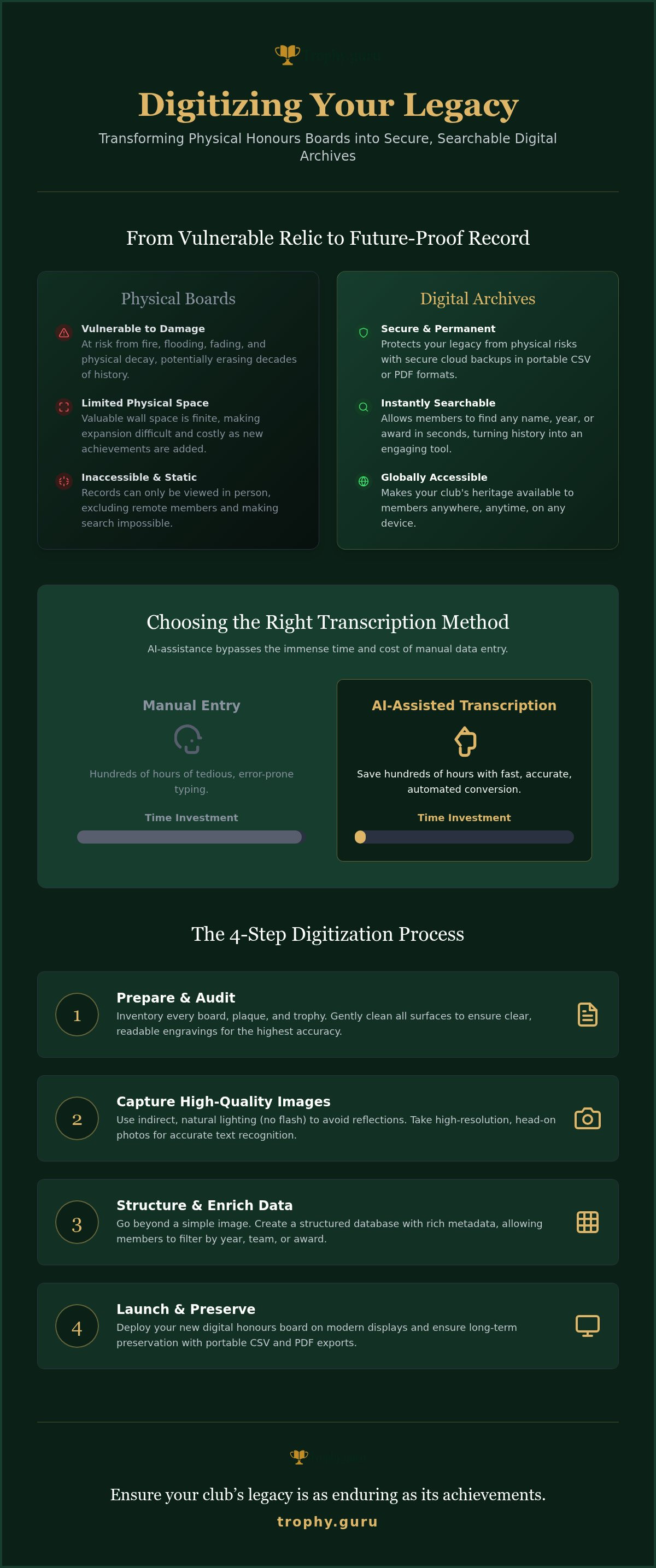
- Protect your club’s legacy from physical risks like fire or fading by converting static boards into secure, searchable digital archives.
- Learn how to digitize old honours boards using AI-assisted transcription to save hundreds of hours compared to manual data entry.
- Prepare your records for success by auditing your collection and cleaning surfaces to ensure every engraving is captured with precision.
- Move beyond simple images by creating a structured database with rich metadata, allowing members to filter results by year, team, or role.
- Future-proof your history with portable CSV exports and modern digital displays that make your club’s heritage accessible from anywhere.
Why Digitising Your Old Honours Boards is Essential for Club Heritage
Honours board digitisation is the methodical process of converting physical, engraved records into a structured and searchable digital format. While these boards are often viewed as permanent fixtures, they are actually vulnerable repositories of a club's legacy. By embracing Digitization, an organisation ensures that its past achievements are not just names on a wall, but accessible data points that can be searched, shared, and secured for future generations.
Relying exclusively on physical records is a risk that many clubs can no longer afford to take. Wood can rot; engravings fade under harsh UV light; and catastrophic events such as fire or flooding can erase a century of heritage in a single afternoon. Transitioning to a digital format offers a sophisticated layer of protection. It creates a secure environment where records remain pristine, regardless of the physical condition of the clubhouse hall. This shift from static wall displays to interactive heritage archives allows the history of the club to become a dynamic resource rather than a dusty relic.
The Limitations of Physical Honours Boards
Physical boards present several practical challenges that hinder modern club management. Most institutions face space constraints; once the walls are full, the cost of adding new boards or extending existing ones becomes prohibitive. Updating traditional boards is also a significant logistical task. Arranging for an engraver to apply gold-leaf lettering on-site involves high fees and scheduling delays. Beyond these physical limits, there is a social cost. Physical boards are inherently exclusive. They only serve the members standing in the room, which means remote alumni and non-resident members are effectively disconnected from the club's ongoing story.
The Benefits of a Searchable Digital Archive
A digital archive transforms how members interact with their history. Instead of scanning hundreds of names on a crowded wall, a user can find a specific record in seconds. This instant search functionality for names, years, and specific awards makes the archive a tool for engagement. Clubs can easily share historical milestones in digital newsletters or on social media platforms. When you learn how to digitize old honours boards, you move beyond simple photography. You create a permanent, portable backup of institutional memory. Having your data in a CSV or PDF format means that even if the physical building is lost, the names and achievements of your members are safely preserved in the cloud. Mastering the process of how to digitize old honours boards allows your club to transition from a passive display to an active, searchable database.
Step-by-Step: Preparing Your Honours Boards for Digitisation
Learning how to digitize old honours boards begins with a thorough physical audit. Before you touch a camera or a keyboard, you must determine the full scope of your project. Walk through your clubhouse or school halls and document every board, plaque, and trophy. This initial inventory helps you understand the volume of data you are handling and ensures that no era of your history is overlooked. It’s a methodical first step that sets the foundation for a complete digital archive.
Once you have identified the boards, prepare them for the camera. Clean each surface with a soft, dry cloth to remove dust or grime that might obscure the lettering. Clear engravings are essential for high-accuracy results. Following the Technical Guidelines for Digitizing Cultural Heritage Materials will help you maintain professional standards during this phase. High-quality source material reduces the need for manual corrections later in the process.
Photography Best Practices for Accurate Transcription
When determining how to digitize old honours boards, the quality of your source image is the single most important factor. Dark-stained wood and polished acrylic often create harsh reflections that can blind a camera lens. To combat this, avoid using a direct flash. Instead, use indirect, natural lighting to highlight the depth of the engraved text. Position yourself directly in front of the board to take a high-resolution, head-on shot. Angled photos distort the text, making it difficult for AI systems to process the characters accurately. If a board is particularly large, take several overlapping close-up photos rather than one distant shot. This level of detail is what allows for a seamless transition from wood to digital data.
Organising Your Historical Sequence
Success in digitisation depends on order. Group your boards by award category, such as sport, academic achievement, or house, rather than just taking photos at random. This structure makes it easier to identify gaps in your records before you begin the data entry phase. If you notice a missing year or a faded name, now is the time to verify those details with physical minute books or old newsletters. Name your digital files clearly using a logical format, such as "Cricket_1stXI_1950_1970.jpg". This systematic naming convention creates a logical archival structure that is easy to navigate. A methodical approach here simplifies the later stages of AI trophy transcription, ensuring that every record is verified and preserved correctly.
Choosing the Right Transcription Method: AI vs. Manual Entry
When a club committee decides how to digitize old honours boards, they usually face a stark choice: assign the task to a dedicated volunteer or use modern technology. Manual entry might seem like the low-cost option, but it's often the most expensive in terms of time and accuracy. A club with a century of history may have thousands of individual names spread across dozens of boards. Transcribing this volume of data by hand can take weeks of continuous, exhausting work.
The Hidden Costs of Manual Data Entry
Volunteer fatigue is a real threat to heritage projects. Most community sports clubs rely on a handful of individuals who are already overstretched. Asking someone to type five thousand names from photos isn't just a big ask; it's a recipe for errors. A single typo in a surname means that record is effectively lost to the search function in your future digital archive. These hidden costs, including the opportunity cost of time that could be spent on membership growth, can derail a project before the archive is even finished. Precision is non-negotiable when dealing with names that represent a club's identity.
How AI Transcription Works for Engravings
AI-powered transcription offers a sophisticated alternative to the manual grind. Standard Optical Character Recognition (OCR) often fails when faced with the three-dimensional shadows of deep engravings or the flourishes of traditional fonts. Modern AI systems are different. They are trained specifically to distinguish between the grain of the wood and the stroke of a letter, even on weathered or faded surfaces. This technology aligns with the Fundamental principles of digitization, which emphasise the importance of data integrity and long-term accessibility.
By using AI Trophy Transcription, you convert images into structured text with a level of precision that manual typing rarely matches. The process is streamlined: the AI identifies the characters, and human verification ensures that every date and name is 100% accurate. Instead of months of manual labour, you pay a one-time transcription fee for a clean, searchable database. You can even start with a free trial for your first record to see the accuracy first-hand. Knowing how to digitize old honours boards using these automated tools ensures your records are not just digital, but actually useful. Once the data is extracted, it can be exported as a secure CSV backup, ensuring your heritage is protected forever.
Creating a Searchable Archive from Your Digitised Records
The core value of knowing how to digitize old honours boards is found in data, not just imagery. While a photograph captures a moment in time, a database captures the narrative of your club. A simple image remains unsearchable; it's a digital copy of the physical limitation you are trying to escape. By converting your boards into a structured archive, you create a resource where every name and date is an indexed entry. This allows for the addition of metadata, such as tagging winners by their specific team or role, which turns a static list into a rich, filterable history.
Data Portability and CSV Exports
Ownership of your institutional memory is vital. You don't want your history trapped in a proprietary system that might become obsolete. By prioritising data portability, you ensure that your records remain accessible through standard formats like CSV or Excel. These files are the gold standard for long-term storage. They allow administrators to easily update membership databases or generate content for anniversary programmes without re-typing old records. A clean CSV archive export acts as a permanent insurance policy for your heritage, ensuring the data remains useful even if you change your display software in a decade.
Building a Searchable Member Portal
A structured database is the engine behind a modern member portal. When you integrate this searchable archive into your club’s website, you provide a bridge between generations. Members can find a relative’s name in seconds, fostering a deeper emotional connection to the club’s past. Filterable categories allow users to browse by specific awards or eras, making the experience both educational and engaging. For more information on the physical hardware needed to showcase this data, see our Best Digital Honours Boards for Sports Clubs: 2026 Guide.
This methodical transition from physical boards to digital order is about utility. It’s about making your history work for you. If you are ready to see your records in a more versatile format, you can start with a free initial trophy transcription to test the accuracy of the process. This ensures your club’s legacy is preserved with precision and care.
Launching Your Digital Honours Board and Engaging Members
The final stage of your project is moving from a private database to a public celebration of your club’s history. Once you have mastered how to digitize old honours boards, the focus shifts to presentation. A digital board shouldn't just sit on a server; it should be the centrepiece of your clubhouse foyer or school hall. This transition ensures that the records you've meticulously preserved are seen and appreciated by the community they represent.
Selecting a Display Platform
Choosing the right hardware is a balance between modern utility and traditional aesthetics. Large TV screens are excellent for high-traffic areas, allowing for rotating displays of winners and historical photos. For a more interactive experience, tablets or touchscreens allow members to search the archive directly from the foyer. Cloud-based hosting is generally more reliable than local storage. In fact, cloud-based archiving solutions commanded over 70% of the market share in 2025 due to their accessibility and ease of integration. When setting up your display, ensure the digital interface reflects your club’s branding, maintaining the same sense of prestige found on the original wooden boards.
Promoting the Archive to Alumni
A digitised archive is a powerful tool for re-engaging past members. You can use your searchable data to create "on this day" social media posts, highlighting a championship win from fifty years ago. This level of detail is a catalyst for fundraising and alumni events. It reminds former members of their personal connection to the institution. During club anniversaries, the digital board becomes a focal point where multiple generations can gather to find their names. It turns a static list into a conversation starter.
Finally, treat your digital archive as a living document. Encourage members to contribute missing information or historical photos to fill any gaps identified during the process of how to digitize old honours boards. This collaborative approach turns the archive into a community project. It ensures your club’s heritage is not just preserved, but actively enriched. Regular updates keep the records current. This reflects the ongoing achievements of your members and maintains the board's relevance for decades to come.
Securing Your Club's Legacy for the Next Generation
Transitioning from static wooden boards to a dynamic digital archive is more than a technical upgrade; it's an act of preservation. By following a methodical approach to how to digitize old honours boards, you ensure that a century of achievements is protected from physical decay and made accessible to every member. You've seen how AI-powered accuracy transforms weathered engravings into structured text, removing the burden of manual entry while eliminating the risk of typos.
The result is a searchable member archive that serves as a living document of your club's identity. With exportable CSV data backups, you maintain total ownership of your history, ensuring it remains portable and secure for decades to come. It's time to move your records from the shadows of the corridor into a format that truly celebrates your alumni. Start digitising your club heritage with a free transcription trial and take the first step toward becoming a modern guardian of your club's tradition.
Frequently Asked Questions
How much does it cost to digitise an old honours board?
Costs are structured as one-time transcription fees based on the volume of records in your collection. Trophy Guru offers a free trial for your first trophy or board record, allowing you to verify the accuracy of the process before committing to a full project. Unlike subscription models that charge annually for software templates, our pricing focuses on the value of the verified data. Specific quotes depend on the scale of your club's archive.
Can AI accurately read names from silver trophies and wooden boards?
Yes, modern AI is specifically trained to distinguish engraved text from the natural grain of wood or reflections on polished silver. While standard OCR often struggles with the shadows of 3D engravings, our specialized AI identifies character strokes with high precision. Every record also undergoes a human verification step to ensure 100% accuracy. This dual-layered approach is the most reliable way to learn how to digitize old honours boards without manual errors.
Do I need a professional photographer to digitise our club records?
You don't need a professional photographer to achieve high-quality results for transcription. Most modern smartphone cameras provide sufficient resolution if you follow basic lighting principles. The key is using indirect, natural light to minimize glare on dark wood or reflective metal surfaces. By taking head-on, high-resolution shots, you provide the AI with the clarity it needs to extract names and dates accurately. We provide guidance on capturing these images yourself.
What happens to the data if we stop using a specific software provider?
Your club's history belongs to you, not a software company. We prioritise data portability by allowing users to export their entire archive into a standard CSV format. This means your records are never trapped in a proprietary system. If you choose to move to a different hosting platform in the future, you can take your verified data with you. This ensures your institutional memory remains accessible and secure regardless of display technology.
How long does the transcription process usually take?
The transcription process is significantly faster than manual data entry, which can take weeks for large archives. Once you upload your photos, the AI processes the images and our team verifies the data for precision. While the exact duration depends on the total number of boards and trophies in your collection, most clubs receive their searchable digital database in a fraction of the time it would take a volunteer to type the records by hand.
Is it possible to export our digitised honours board to Excel or CSV?
Yes, every digitised record can be exported as a CSV file, which is fully compatible with Microsoft Excel and other database software. This feature is essential for club administrators who need to cross-reference honours board winners with membership databases or hall-of-fame projects. Having a portable backup in a universal format is a critical step for anyone learning how to digitize old honours boards, as it provides a permanent record.
Can we add new winners to the digital honours board ourselves?
Our hosting platform is designed to be a living document of your club's ongoing achievements. You can easily update your digital board with new winners as they are announced each season. This eliminates the logistical delays and high costs associated with traditional gold-leaf engraving or physical board extensions. By managing the records yourself through a simple interface, you ensure your clubhouse display remains current and reflects the latest successes of your members.
Is a digital honours board legal for official school or military records?
Digital records are widely accepted as a valid form of institutional archiving, provided they meet standard data integrity requirements. For schools and military organisations, a digital archive often serves as a superior backup to physical boards that are susceptible to environmental damage or fire. While you should always consult your specific governing body's regulations, a searchable database with verified data and secure CSV backups aligns with modern digital preservation standards used worldwide.


