

True school award record digitization isn't simply about scanning paper registers; it's about liberating decades of student achievement trapped in tarnished silver, etched brass, and fading wooden boards. Every school archivist and administrator knows the frustration. Honours boards are running out of physical wall space, cabinet glass reflects glare rather than glory, and manually transcribing thousands of names from curved metal into a spreadsheet is an exhausting, error-prone task that nobody has the hours to complete.
Your school's heritage deserves better than forgotten cabinets, but protecting it shouldn't require weeks of tedious data entry. In this 2026 preservation guide, you'll learn the precise steps to transform dusty trophy cabinets and wooden honours boards into a searchable, permanent digital archive for your school. We'll cover everything from multi-angle photo capture to AI-assisted transcription and simple CSV exports, giving you a streamlined roadmap to reconnect alumni with their history and keep records current year after year.
Key Takeaways
- Understand why modern school award record digitization requires moving beyond passive photography to structured, searchable data extraction.
- Learn practical photo capture techniques that eliminate glare and distortion on curved silverware and reflective honours boards.
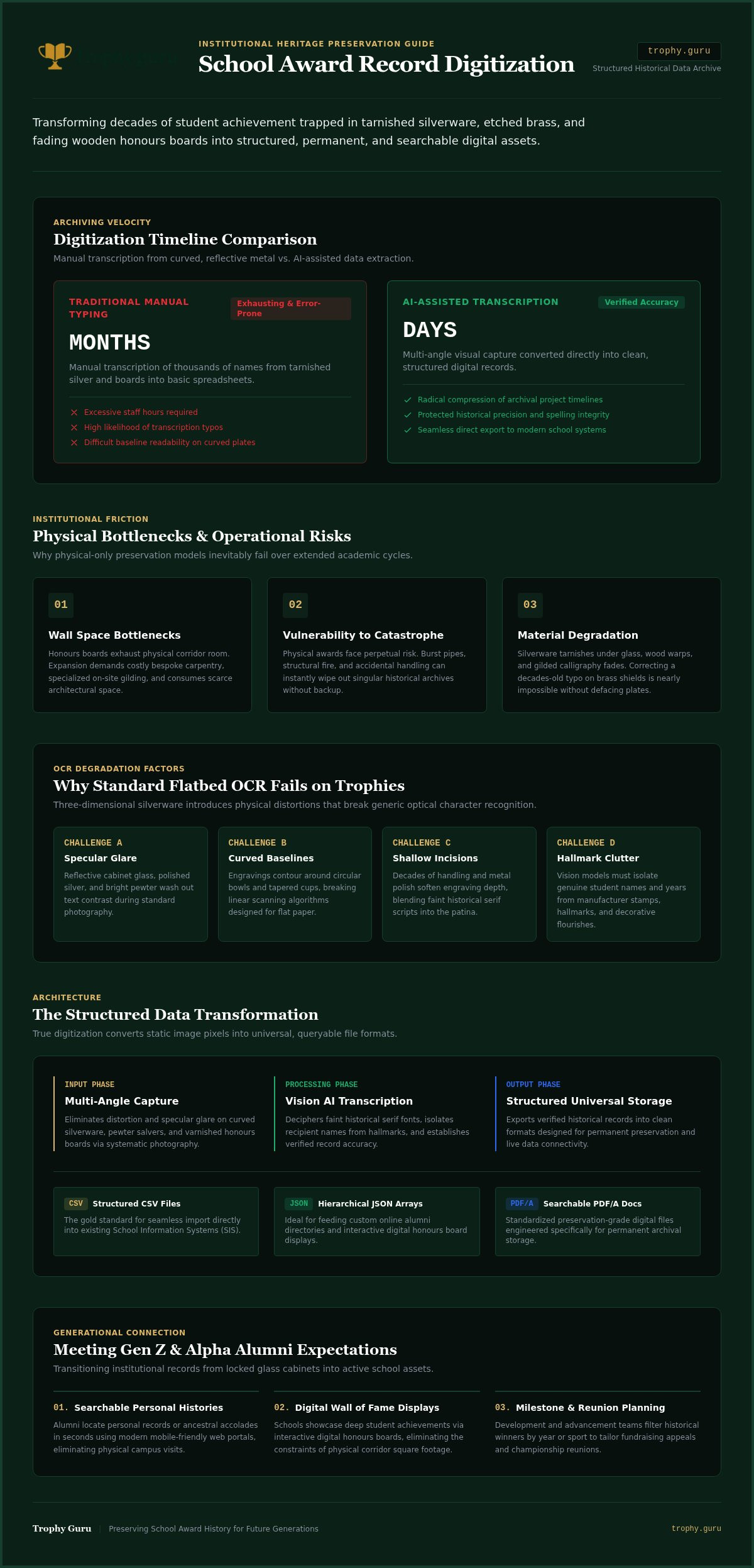
- Replace tedious manual typing with AI-assisted transcription to cut archiving timelines from months to days while protecting accuracy.
- Use clean CSV archive exports to connect historic achievements seamlessly with your school management and alumni systems.
- Discover how interactive, cloud-hosted honours boards celebrate past winners and resolve physical wall space limits for good.
Why School Award Record Digitisation is Essential for Modern Institutions
School award record digitisation means converting physical engravings, gilded calligraphy, and wooden plaques into structured, searchable data. For decades, academic institutions treated digital transformation purely as a classroom initiative, upgrading whiteboards and student laptops. Yet a school's institutional heritage remained trapped in the corridor. When physical trophy cabinets fill up and wooden honours boards run out of wall space, celebrating student excellence turns into an administrative headache.
Every school faces the same dilemma: preserve history or clear the walls. Expanding physical boards requires expensive carpentry, specialized on-site gilding, and scarce corridor space. Digitising these records solves the space bottleneck while turning static artifacts into active assets. Structured award data integrates directly into development campaigns, helping advancement teams reconnect with former prize winners, verify legacy admissions, and celebrate past championship teams during major fundraising appeals.
The Fragility of Physical Heritage
Physical awards face perpetual risk. Fire, burst pipes, and accidental handling can erase unique student records overnight. Wooden boards warp, lettering fades, and silver tarnishes under glass. Worse, correcting a decades-old typographical error on an engraved brass shield is nearly impossible without defacing the plate. Adhering to established digital preservation best practices provides the operational redundancy modern institutions require. Converting physical engravings into verified digital records ensures your school's timeline survives physical loss intact.
Meeting the Expectations of Gen Z and Alpha Alumni
Younger alumni expect their history to be accessible anywhere. They do not visit the physical campus just to squint through glass at a 1998 track trophy. They expect instant, digital access:
- Searchable personal histories: Alumni can find their own records or family accolades in seconds using mobile-friendly web portals.
- Interactive Wall of Fame displays: Schools can present rich student achievements on public-facing digital honours boards without using valuable hallway real estate.
- Reunion and milestone planning: Event coordinators can filter past winners by year or sport to organise tailored anniversary celebrations.
Embracing school award record digitization bridges the divide between proud traditions and modern accessibility, giving your community a dynamic archive that lasts.
Understanding the Digitisation Landscape: From Certificates to Silverware
Every school archive contains a mix of formats. There are flat oak honours boards, bound paper prize-giving programmes, and three-dimensional silver cups. Preserving them effectively requires understanding the difference between simple visual capture and true data recovery. Taking a digital photo protects an image of an object, but taking a snapshot is not school award record digitization. A high-resolution JPEG of an engraved bowl cannot be queried by student surname, exported to your alumni database, or filtered by graduation year.
Data extraction transforms static pixels into structured records. While paper registers can be digitized following standard Library of Congress preservation scanning guidelines, three-dimensional physical awards demand a different methodology. The final objective is clean, portable information stored in universal formats:
- Structured CSV files: The gold standard for importing award histories directly into existing School Information Systems (SIS).
- Hierarchical JSON arrays: Ideal for building interactive web applications and custom online alumni directories.
- Searchable PDF/A documents: Preservation-grade digital files suited for long-term document storage.
Challenges of Transcribing Trophy Engravings
Standard flatbed optical character recognition (OCR) fails completely on three-dimensional silverware. Silver cups and pewter salvers present specular glare, curved letter baselines, and shallow, tarnished incisions. Generic OCR tools frequently misread characters on curved metallic surfaces. Overcoming this requires specialized vision AI capable of synthesizing multiple overlapping angles, deciphering faint serif scripts, and accurately isolating recipient names from intricate historical hallmarks.
Digital Honours Board vs. Physical Displays
Traditional wood-and-gold boards demand continual maintenance. Sourcing specialized signwriters for annual updates incurs recurring bills, and matching historical typefaces becomes harder as decades pass. Virtual boards eliminate those recurring expenses entirely while providing unlimited room for expansion.
Adopting modern systems lets institutions showcase unlimited sports, academic, and arts achievements without claiming additional hallway walls. Exploring modern digital recognition boards for schools reveals how easily web-hosted interfaces can replace static timber. If you want to see how your own physical collection translates into structured data, you can test the process using Trophy Guru's transcription tools to turn your first trophy photos into verified records.
Comparing Digitisation Methods: Manual Data Entry vs. AI Transcription
Most archival initiatives stall at the transcription stage. Faced with hundreds of plaques, shields, and silver cups, administrative teams assume the only path forward is assigning staff or parent volunteers to type every surname and date into a blank spreadsheet. This manual approach is slow, expensive, and fragile. AI-assisted transcription changes this workflow fundamentally, condensing months of tedious data extraction into a matter of days.
Modern preservation combines specialized machine vision with human verification. This "human-in-the-loop" model aligns directly with rigorous National Archives digitization standards, which require structured verification protocols rather than unvetted imports. The system parses multi-angle imagery, maps circular text, and extracts names and dates for quick human approval. The result is speed without sacrificing fidelity.
The Manual Entry Trap
Manual keyboard entry carries hidden costs that drain school budgets. Consider the true trade-offs:
- The boredom error rate: After typing names from twenty consecutive shield plaques, fatigue causes transcribers to miss historical spelling anomalies or transpose calendar years.
- Compounded errors: Typographical errors introduced during manual entry become permanent entries in the central database, distorting the historical record.
- Process abandonment: Because manual transcription requires dozens of uninterrupted hours, projects frequently stall after the first cabinet, leaving the school with fragmented, half-finished files.
The Rise of AI Trophy Transcription
Institutions are replacing manual entry with specialized computer vision. Dedicated AI trophy engraving transcription services read text directly from multi-angle photographs, identifying names, years, and categories automatically across tarnished or reflective surfaces. Rather than typing from scratch, school archivists simply review side-by-side comparisons of the original image and the extracted text to confirm accuracy.
This automated approach simplifies compliance and budgeting. Trophy Guru processes text with strict adherence to student data protection frameworks, extracting verified directory information while ensuring schools retain total data ownership via portable CSV exports. Rather than forcing schools into ongoing, multi-year software subscriptions, a transparent pay-once credit model keeps school award record digitization within budget for independent archives and state schools alike.
A Step-by-Step Guide to Digitising Your School’s Award History
Executing a reliable school award record digitization project requires a structured, repeatable methodology. Rather than photographing items haphazardly, following a defined five-stage workflow keeps your historical data organized, accurate, and ready for public display.
- Inventory and Audit: Document every physical honours board, silver cup, shield, and framed certificate across campus. Note the award category, date range, and current condition.
- Photography: Capture clean, high-resolution source photographs of every plaque and inscription using proper diffusion techniques.
- Transcription: Process the images through specialized AI vision to transcribe names, years, and specific award titles automatically.
- Verification: Perform a human-in-the-loop review, cross-checking the extracted text against the original photos to catch anomalies.
- Implementation: Export the clean records to your central archives or publish them directly to a modern trophy database for schools.
Photography Techniques for Reflective Awards
High specular reflections on silver and brass ruin OCR read rates. Never use a direct camera flash; it creates bright hot spots that obliterate shallow engravings. Instead, position your items under indirect, diffused ambient lighting. Set up matte foam boards or white sheets around the trophy to block ambient room reflections. Always shoot square-on to flat plaques to prevent perspective distortion. For cylindrical cups or rounded wooden plinths, rotate the item slightly between shots, taking overlapping close-up photos to ensure continuous text lines remain sharp and legible.
Organising Your Digital Archive
A systematic naming structure prevents chaos when handling thousands of historical files. Name your image files logically before transcription: [YearEstablished]_[AwardName]_[SideNumber].jpg. Within the database, tag every award record across core taxonomies:
- Academic discipline or sport: Track, Senior Rugby, Debating, or Dux Litterarum.
- Temporal data: Academic year, term, and specific date of presentation.
- House or cohort alignment: Linking individual winners to specific school houses or graduating classes.
Once structured, export the entire database as a clean CSV file. This gives you complete data portability, allowing you to import your archive into existing student management software without vendor lock-in. Ready to streamline your collection? You can digitize your school awards with Trophy Guru today and turn physical silverware into an organized digital collection in minutes.
Future-Proofing Your School’s Legacy with Trophy Guru
Safeguarding decades of student accomplishment does not require technical complexity or open-ended budget approvals. Trophy Guru simplifies this transition, converting raw photographs of cups, boards, and shields into structured, searchable digital assets. For school bursars and development directors balancing competing priorities, the platform's transparent pay-as-you-go credit structure removes financial uncertainty. Credits do not expire, and you avoid mandatory software subscriptions. You pay once to transcribe your heritage, keeping lifetime custody of the data via complete CSV exports.
Testing the technology carries no upfront financial commitment. Through Trophy Guru's free initial trophy transcription, schools can upload up to 12 source photographs of an intricate, curved trophy or multi-column honours board without entering a credit card. The system processes the imagery, delivers an AI-assisted transcription, and generates a clean vector-style illustration of the award on a transparent background, letting you evaluate accuracy firsthand.
Building a Searchable Hall of Fame
Transforming records into live web displays unlocks powerful benefits for the broader school community:
- Instant alumni discovery: Former pupils can search by surname, year, or discipline from any browser, locating their past accomplishments in seconds.
- Dynamic institutional communications: Advancement offices can embed direct links to specific historical award records across weekly alumni newsletters and reunion announcements.
- Current pupil inspiration: Seeing historic names preserved alongside current achievements reinforces institutional culture and gives active students a tangible sense of permanent recognition.
Getting Started with Digitising School Trophy Records
Launching a pilot project is straightforward. Begin by selecting a single display cabinet or an individual sport, gathering around five to ten historic awards. If you need a comprehensive operational walk-through before starting, consult our practical guide on digitising school trophy records to plan your team's workflow and equipment setup.
Once your pilot batch confirms extraction fidelity, scaling the archive across your entire campus becomes predictable and affordable. Annual updates require only photographing new additions each prize-giving term, ensuring your digital archive stays current without recurring overhead. Every piece of your history deserves visibility. Start your school's digital archive today with a free transcription and safeguard your school award record digitization for generations to come.
Preserving Your School's Heritage for the Next Generation
Safeguarding your institution's history shouldn't mean letting decades of student pride gather dust behind glass or fade on wooden boards. True school award record digitization moves beyond passive photos to create an accessible, searchable archive. By replacing manual typing with AI-assisted transcription, you protect historical accuracy, eliminate wall space constraints, and unlock seamless CSV exports for your existing school systems.
Built with AI-powered accuracy for heritage records and trusted by leading UK educational institutions, Trophy Guru offers a straightforward one-time payment structure with no recurring subscription fees. You retain complete ownership of your data while giving your community an interactive honours board that inspires current pupils and reconnects alumni worldwide. Ready to test the technology on your own collection? Digitise your first school trophy for free with Trophy Guru and start building a permanent legacy today.
Frequently Asked Questions
How do I digitise an old wooden honours board?
Photograph the board straight-on in sections under even, indirect light to eliminate varnish glare. Once you have clear, high-resolution images, upload them to an AI transcription service to extract the calligraphed or gilded names and dates into structured text. Review the digital output against your photos, then import the verified data into an online honours board or archive. This preserves fragile woodwork without risking physical damage during handling.
Can AI really read names engraved on a curved silver trophy?
Yes, modern multi-angle computer vision handles curved silver accurately. Unlike generic flatbed OCR, specialized vision models analyze multiple overlapping photographs to account for surface curvature, shallow incisions, and metallic reflections. The system stitches these perspectives together to transcribe names and years into an editable review dashboard. A human-in-the-loop review ensures historical quirks or worn hallmarks are verified before final archiving.
What is the best file format for a school award database?
A standard, UTF-8 encoded CSV file offers the best long-term portability for school award record digitization. CSV files integrate easily with modern School Information Systems, spreadsheets, and alumni databases without locking you into proprietary software formats. For visual presentations and web archives, pairing your raw CSV data with structured JSON arrays and high-resolution master images ensures your records remain flexible and future-proof across modern web displays.
How much does it cost to digitise a school's entire trophy collection?
Costs depend on your collection size, but modern AI transcription avoids expensive manual labor or recurring software retainers. Services like Trophy Guru operate on a transparent pay-as-you-go credit model where credits never expire, alongside a free trial to process your first trophy without financial commitment. This pay-once approach ensures independent and state schools can digitize large historical collections within predictable budgets without worrying about annual software subscriptions.
Is it better to use a spreadsheet or dedicated software for award records?
Spreadsheets work well as raw storage, but dedicated cloud software provides far greater utility for schools. A simple spreadsheet is prone to accidental edits, lacks visual appeal, and cannot easily engage alumni or pupils. Dedicated digital honours board software pairs your underlying structured database with a searchable, interactive public interface. This allows visitors to filter by year, recipient, or award while keeping administrative records secure behind the scenes.
How can we display our digital award records in the school hall?
You don't need expensive, proprietary kiosk hardware. Modern digital honours boards are responsive web applications that run smoothly on commercial wall-mounted screens or standard smart TVs via a simple web browser. You can also mount modest QR code plaques next to physical trophy cabinets, allowing pupils, parents, and visiting alumni to browse the school's complete award history directly on their personal mobile devices.
Do we need to send our trophies away for transcription?
No, physical silverware never leaves your campus. All transcription takes place digitally from photographs you take on-site using a standard smartphone or digital camera. This eliminates courier costs, transit insurance, and the risk of damaging irreplaceable school heirlooms. You photograph the items in their display cabinets or on an archive table, upload the images, and let AI-assisted software handle the transcription remotely.
Can we export our digital records to Excel or CSV?
Yes, full data portability is an essential feature of modern school award record digitization. You can export your entire catalog of recipient names, award categories, and historical years into a clean CSV file at any time. This structured file opens directly in Microsoft Excel, Google Sheets, or institutional database systems, ensuring your school retains complete ownership of its historical data without vendor lock-in.


