

What if a name on a long-serving club trophy could be found in seconds, along with the season and competition it represents? For many clubs, those details are scattered across worn engravings, handwritten lists, photographs and old documents. Well-organised cricket club trophy archives bring these records together while preserving the stories behind them.
It’s understandable if the task feels daunting. Names may be difficult to read, dates may not match, and volunteers need a process they can maintain. The key is not to treat every transcription as fact. Create a searchable record, keep the source material and check uncertain details before sharing them.
This practical case study for 2026 explores how a club could move from scattered records to a verified, accessible archive. It covers gathering and transcribing evidence, checking names and competition details, and organising entries so members can search by winner, year or competition. It also considers how AI-assisted transcription, an online honours board and CSV export can support the work, with human checks to add context and confirm details.
Key Takeaways
- See how cricket club trophy archives can connect winners and awards with dates and supporting sources, preserving context as well as results.
- Learn how to turn photographs of trophies, honours boards and result sheets into records, then check uncertain details against the originals.
- Compare physical boards, paper ledgers, spreadsheets and online archives to decide which formats suit your club’s access and record-keeping needs.
- Follow a manageable plan to inventory, prioritise, transcribe and review honours, starting with records members consult most often.
- Discover how Trophy Guru’s image-based transcription, searchable archive and CSV export may support the process, including one free initial trophy transcription.
Why cricket club trophy archives are more than a list of winners
A club’s honours may be on display, but the evidence behind them can be harder to find. A trophy might show a winner’s name but not the year; an old scorebook may record a match but not its competition; a result sheet might be stored separately from both. An archive connects these fragments so members can explore the club’s history and distinguish confirmed details from uncertainties.
This case study is illustrative, not a report of a named club or verified project. It shows the types of records and checks a club could use to build an archive responsibly. The principle is straightforward: preserve the original evidence, record only what it supports, and flag details that still need checking. This approach reflects the wider aims of digital preservation, which focuses on keeping information accessible over time.
What belongs in a cricket club trophy archive?
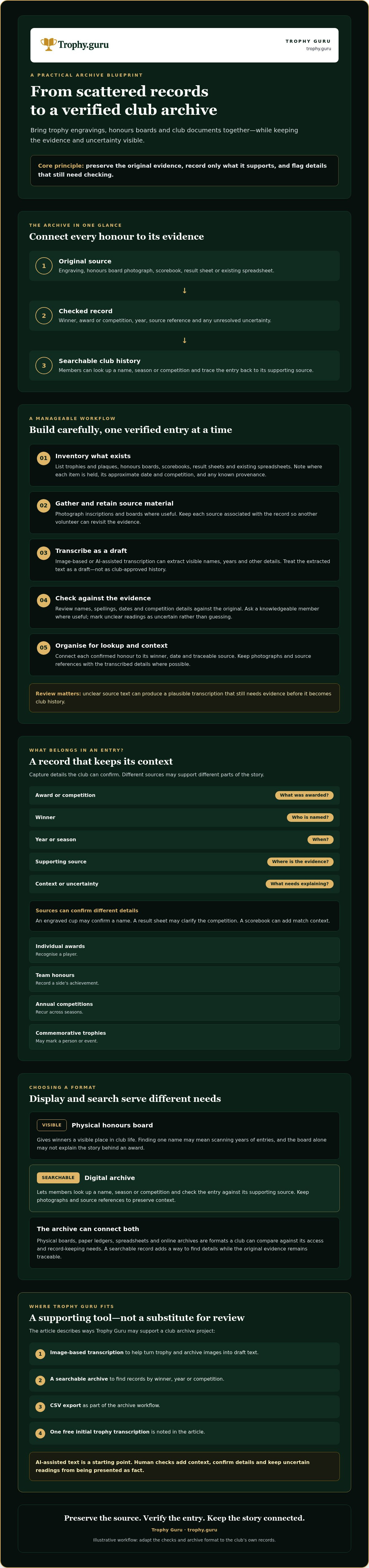
Useful cricket club trophy archives connect each award to details the club can confirm. An entry might include the award or competition name, winner, year and a note identifying its source, such as a trophy engraving, honours board photograph, scorebook or result sheet. Each source can support different details: an engraved cup may confirm a name, while a result sheet may clarify the competition. A scorebook can add context about the match.
Keep categories clear. Individual awards recognise a player; team honours record a side’s achievement; annual competitions recur across seasons; commemorative trophies may mark a person or event. If an engraving is difficult to read or sources disagree, record the uncertainty rather than filling the gap with a guess. That gives future volunteers a specific question to investigate.
Why physical honours need searchable records
An honours board gives winners a visible place in club life. But finding one name among years of entries may mean scanning the whole board, and the board alone may not explain the story behind an award. A searchable record lets members look up a name, season or competition, then check the entry against its supporting source. Keep photographs and source references with the transcribed details where possible, so convenience doesn’t replace context.
An archive is a set of linked records that connects each honour to its winner, date and traceable supporting source. That connection helps members check club milestones and distinguish documented history from assumptions. It also allows the archive to grow carefully, one verified entry at a time.
How the club’s trophy records become a verified digital archive
A reliable archive starts with evidence, not data entry. Because this case study isn’t based on records from a named club, the workflow below is illustrative and can be adapted to a club’s own collection. The aim is to retain the source of each detail, distinguish machine-extracted text from club-approved information, and publish entries only after they’ve been checked.
Gather source material and preserve its context
Start by listing the records the club already holds: physical trophies and plaques, honours boards, scorebooks, result sheets and existing spreadsheets. For each item, note where it is held, its approximate date and competition, and any known provenance. A photograph of an engraving, for example, may show a player’s name and year; a result sheet may help confirm the competition. Keep sources associated with the resulting entry so another volunteer can revisit the evidence. Sport New Zealand’s practical plan for documenting club history also offers useful context for approaching the work as a shared record of club life.
Transcribe, check, and organise each entry
Photographs of trophies, plaques, honours boards or result sheets can provide text for transcription. AI-assisted transcription can extract visible names, years and other details, giving volunteers a draft to review. It can’t determine what an unclear engraving was intended to say or resolve conflicting records on its own. Keep extracted text separate from the club-approved entry until someone has checked it against the source and, where useful, asked a knowledgeable member to review spellings, dates or competition names.
Human review matters because unclear source text can produce a plausible transcription that still needs evidence before it becomes club history. Mark uncertain readings as uncertain rather than silently choosing one version.
- Inventory: List available records and where they’re held.
- Prioritise: Choose a manageable group of awards to begin with.
- Transcribe: Use clear photographs as inputs for text extraction.
- Verify: Compare names, years and competitions with the source and other records.
- Approve and publish: Record the checked details, retain source references, and make approved entries searchable.
This staged approach turns cricket club trophy archives into reviewable records rather than a batch of unverified text. If image-based transcription and searchable honours records would help your club organise its sources, you can explore Trophy Guru’s archive and transcription option.
Digital archive or traditional records: what suits a cricket club?
No single format has to do everything. An engraved board can celebrate honours in the clubhouse, while a ledger or spreadsheet can hold details that aren’t practical to display. A searchable online archive can make those records easier to browse. For cricket club trophy archives, consider how each format will be used, checked and maintained.
When physical boards and spreadsheets still work well
An honours board offers immediate visibility and ceremony. It gives players and visitors a shared place to recognise achievement. A paper ledger can preserve handwritten notes and historical context, while a spreadsheet may suit a small set of current awards if someone keeps its fields consistent. These formats have limits: records can be spread across files, and a name in a spreadsheet may be difficult to trace to its original source unless the reference is recorded.
When a searchable online archive may help
A digital archive can help when a collection spans multiple trophies and record formats, or when members want to search by name, year or award without being at the clubhouse. It can complement the honours board rather than replace it. CSV export can also make archive data available for other record-keeping tools, but an exported file still needs consistent fields, clear ownership and review.
| Format | Searchability | Source context | Access | Maintenance | Export options |
|---|---|---|---|---|---|
| Engraved board | Visual scanning | Honour is visible; supporting evidence may be separate | Usually on display at the club | Physical updates may be needed | None built in |
| Paper ledger | Manual lookup | May include handwritten notes | Depends on where it’s stored | Requires careful handling and continued entries | None built in |
| Spreadsheet | Search and filters, if organised consistently | Can include source notes, but these need to be added | Depends on how the file is shared | Needs an owner and consistent updates | Can be saved or exported in suitable formats |
| Searchable online archive | Can support searches by recorded fields | Can link entries to source details | Can support online browsing | Needs review and ongoing care | CSV export may be available |
Digitising isn’t valuable simply because records appear on screen. Unchecked names, missing dates or inconsistent competition labels can make a digital collection hard to trust. Choose a format that fits how members will use the records, keep original honours where they matter, and make sure someone can review and maintain the archive.
A practical plan for building and maintaining cricket trophy archives
A manageable archive is built in stages and maintained by someone who knows how it works. Before processing a large collection, agree what information to record and how to handle uncertain details. Start with a small group of high-value or frequently consulted trophies, such as a prominent annual award, then refine the process before expanding.
- Appoint an owner. Give one volunteer responsibility for coordinating the archive and recording decisions. They can involve other members to identify sources or review historical details.
- Inventory the records. List trophies, boards, ledgers, result sheets and digital files, noting where each is held and what period it may cover.
- Prioritise a starting set. Choose awards members often ask about or records that may become difficult to access.
- Transcribe and verify. Record the available details, then check names, dates and competition titles against source material or other reliable club records.
- Review and extend. Check the first entries for consistency, address gaps and add further records in manageable batches.
Set standards for names, dates, and competition records
Choose consistent fields before entering a large collection: award or competition, winner, year, category and source reference. Agree how to handle spellings, initials and date formats. If a competition title or name is standardised to make searching easier, retain the original wording or a source note as well. Mark details as missing, disputed or unreadable rather than silently filling them in.
Plan member access and long-term stewardship
Decide who can view records, who may edit them, who approves changes and who can export data. Set a simple correction process: record the proposed change, check it against evidence, then note who approved it. Keep backup copies of the archive and its supporting records, and check periodically that they remain accessible. After each season, assign someone to add new winners and review those entries before publishing them.
These habits help cricket club trophy archives remain useful beyond the initial project. For broader context, clubs can consult guidance on organising club archives and digitising historical records, choosing resources that suit their collection and capacity. To see how image-based transcription and searchable honours records could fit into your process, explore Trophy Guru’s archive and transcription workflow.
Where Trophy Guru fits in a cricket club archive project
Once a club has chosen its records and review process, transcription can help turn visible details into searchable entries. Trophy Guru uses AI-assisted transcription to extract names, years and other details from photographs of trophies, plaques, honours boards and result sheets. The club supplies the photographs; the service doesn’t provide on-site photography.
What Trophy Guru can contribute to the workflow
Extracted text is a starting point, not an approved historical record. Club members should compare names, dates and competition details with the original image and any supporting records, especially where an engraving is unclear or sources conflict. Flag uncertain details for review rather than treating a machine reading as confirmation.
Approved entries can form a searchable online archive, helping members browse recorded honours and search for names, years or awards. CSV export can also make archive data available for use in a spreadsheet or another club records process. It doesn’t replace the club’s responsibility to maintain consistent information, retain source context and check changes.
Trophy Guru offers one initial trophy transcription free; processing additional trophies is paid. Check the current workflow and terms before beginning a larger project.
How to decide whether to try a transcription workflow
Choose a small, representative set of records first: perhaps one clear engraving, one more difficult inscription, and an honours board or result sheet entry. Check that the photographs show the text legibly. Then assess whether the extracted details are useful, how much member review is needed, whether the archive supports the access members want, and whether CSV export fits the club’s record-keeping.
This measured test helps a club decide whether the approach suits its cricket club trophy archives without assuming particular results in advance. If you’re ready to assess the process using one record, try one trophy transcription with Trophy Guru.
Take the first step towards preserving your club’s honours
A dependable archive doesn’t need to begin with every trophy and record at once. Start with a manageable group, keep each entry connected to its source, and have club members check uncertain names, dates and competition details before sharing them. That care helps cricket club trophy archives preserve the meaning behind each honour as well as the result.
The right format should suit your club. Physical honours can remain on display, while searchable records make it easier to look up past winners and seasons. AI-assisted transcription from trophy and honours board photographs can help create those records, with club review still essential. A searchable archive and CSV export can support browsing and record-keeping.
Trophy Guru offers one free initial trophy transcription, giving your club a practical way to explore the workflow with a single record. Try one trophy transcription with Trophy Guru, then decide whether the approach fits your archive. Each carefully checked entry helps keep club history accessible for future members.
Frequently Asked Questions
How do you create a digital archive of cricket club trophies?
Create a digital archive by listing the club’s awards and source records, choosing consistent entry fields, then transcribing and checking details before publishing them. Start with a manageable group of trophies or honours-board entries. Link each record to its supporting source, flag anything uncertain and decide who will maintain the archive. Trophy Guru offers one initial trophy transcription free; processing additional trophies is paid.
What information should a cricket club trophy archive include?
A useful archive should include the award or competition name, winner, year and a reference to the source that supports the entry. Clubs may also record whether an honour is individual, team-based, annual or commemorative. Add useful context where it can be confirmed, such as the source’s location or the original wording of an inscription. Mark missing, disputed or unreadable details clearly instead of guessing.
Can AI read names engraved on old cricket trophies?
AI-assisted transcription can extract visible names, years and other details from photographs of trophies, plaques and honours boards. The result depends on what the image shows: worn engravings, reflections, unusual lettering or a blurred photograph may leave text unclear. Treat the transcription as a draft, not proof. A club member should compare it with the source and flag uncertain readings for further checking.
How can a cricket club check whether digitised trophy records are accurate?
Check each entry against its original photograph and other relevant club records, such as a result sheet or scorebook. Review names, years and competition titles, paying particular attention to similar spellings, unclear engravings and conflicting dates. Ask a knowledgeable member to help where needed. Keep a note of the source and record corrections through an agreed review process, so later volunteers can understand why details changed.
Should a club replace its physical honours board with a digital archive?
No, a digital archive can complement rather than replace a physical honours board. The board gives recognition a visible, ceremonial place at the club; a digital record can make entries easier to find and retain supporting details. A club might keep its display as it is while adding searchable records for members who want to explore winners, seasons or awards beyond what’s easy to locate on the board.
Can members search cricket trophy winners by name or year?
Yes, members can search winners by name or year when those details have been transcribed into a searchable archive. Other recorded fields, such as competition or award name, can also help narrow a search. Results are only as dependable as the information entered, so check spellings and dates against source records and make unclear entries easy to distinguish from confirmed ones.
Can cricket club archive records be exported to a spreadsheet?
Yes, Trophy Guru supports CSV archive export, which can be opened in spreadsheet software and reused for club record-keeping. An export can help administrators work with archive entries outside the online honours board, but it doesn’t replace consistent fields, source references or a process for approving corrections. Check the exported data before relying on it, particularly if records have been updated or reviewed in stages.


