

What if your club’s history is scattered across trophy engravings, result sheets, plaques and members’ personal collections? To digitize historical club records, you don’t need to tackle every box and inscription at once. Start with a clear process that turns scattered sources into records people can find and use.
It’s understandable if the project feels difficult to fit around the club’s usual responsibilities. Names may be faded, dates unclear and achievements hard to confirm. Scanning everything in a rush can preserve the confusion along with the history.
This practical five-step guide shows you how to choose what to digitise first, capture records clearly, check details against available evidence and organise the results for future use. You’ll also learn how to flag uncertainty rather than present a guess as fact.
Each step moves records from physical sources towards a searchable digital archive. The aim is not simply to create digital copies, but to build a dependable record that supports future club projects and helps members explore past achievements.
Key Takeaways
- Digitize historical club records in a manageable sequence, starting with a small batch of valuable records rather than the entire collection.
- Choose scanning, manual entry or AI-assisted transcription to suit the source. An image-only scan isn’t searchable text.
- Check names, dates and results against the original source, and flag uncertain readings instead of guessing.
- Use consistent organisation to make reviewed records easier to find and reuse for enquiries, anniversaries and future club projects.
- A searchable archive and CSV export can help make transcribed trophy, plaque, honours-board and result-sheet records more useful.
Why digitize historical club records before they become harder to use?
A club’s history may be spread across a trophy cabinet, result sheets, an old minute book and photographs held by former members. These records can be deeply valued but difficult to find, read or hand over when volunteers change. Faded inscriptions and fragile paper add urgency: information can be harder to recover if its source is misplaced or deteriorates.
Digitising makes records easier to access. Members can look up past winners, volunteers can hand over organised information instead of relying on personal knowledge, and verified details can support anniversary material or club communications. A digital copy isn’t a substitute for caring for the original. Digital preservation involves more than making a copy; it means taking steps to keep digital material accessible over time. Protect physical items, and use digitisation to make their information easier to find and use.
A digital club archive is an organised collection of digital records and descriptions that helps people find and check the club’s history. It can grow gradually. You don’t need to digitise every item before the archive becomes useful.
Which historical club records are worth digitising first?
Start by listing what the club holds: trophies, plaques, honours boards, result sheets, minute books, programmes and photographs. Then prioritise items that are fragile, important to the community or often requested. A frequently consulted honours board may be a useful first batch; a rarely used box of routine papers can wait.
Match the method to the source. A photograph or programme may need a clear digital image and a short description. A trophy engraving or result sheet may also benefit from a transcription of names, years and achievements. Some records need both: an image preserves the appearance of the source, while text makes key details searchable. Record where each item came from so its context isn’t lost.
What a useful digital club archive should help people do
Plan the archive around real tasks. Can a member find a name, year, team or achievement? Can a volunteer trace an entry to its source and check the wording? Keep a source reference, such as an item label or collection name, alongside each record. If a reading is unclear, flag it for review rather than turning an uncertain interpretation into a fact.
Set a realistic starting point. You might capture a small group of high-value items first, then transcribe only the details people are most likely to search for. This gives the club a useful foundation without making the project feel endless, and leaves room to add records as time and evidence allow.
How to digitize historical club records in five manageable steps
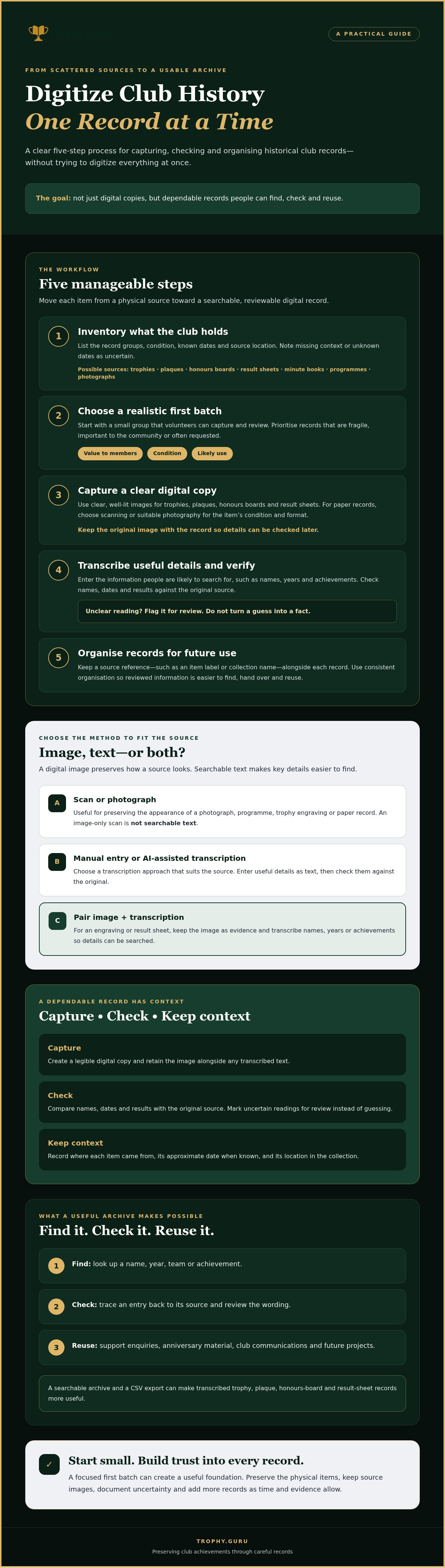
To digitize historical club records without turning the task into an endless volunteer project, work in small batches and move each item through the same process. Begin with records the club values or needs most, then build on what you learn. For broader planning, see this practical checklist for preserving club history online.
Build an inventory and choose a realistic first batch
List the main record groups, their condition, any known date range and their likely value to members or researchers. Choose a batch volunteers can capture and review, such as one shelf of trophies or a folder of result sheets. Assign someone to coordinate the process, and consult digitization best practices when setting the project’s purpose and approach.
For each item, note its source type, approximate date, location in the collection and digitisation status. Mark unknown dates or missing context as uncertain rather than filling gaps with assumptions.
Capture records and create a reviewable digital copy
Take clear, well-lit images of trophies, plaques, honours boards and result sheets. For paper records, choose scanning or suitable photography according to the item’s condition and format. Keep the original image with any transcribed text so a reviewer can compare the entry with its source.
- Inventory: List what the club holds and record condition, dates and source location.
- Prioritise: Select a manageable first batch based on value, condition and likely use.
- Capture: Create a legible digital copy and keep the source image with the item’s record.
- Transcribe and verify: Enter useful details such as names, years and achievements, then check them against the source. Flag unclear readings for review.
- Organise and maintain: Use consistent labels, update each item’s status and keep the inventory current as records are added.
At each handover, make sure the next volunteer can see what has been captured, what still needs checking and where the original came from. A repeatable process matters more than a large first batch. If trophies, plaques, honours boards or result sheets are part of your priority collection, Trophy Guru’s AI-assisted trophy transcription may help extract details for review.
Scanning, spreadsheets, and AI transcription: which method fits each record?
The right method depends on what the source contains and how people will use it. A digital image preserves appearance, manual entry gives a volunteer control over interpretation, and AI-assisted transcription can help extract text from supported images. These approaches can work together, but they don’t produce the same result.
An image-only scan isn’t automatically searchable text. It lets someone view the page or inscription, but finding a particular name may still mean reading through the image. Searchable records need text as well as, ideally, the original image for reference.
When scanning or manual entry is the practical choice
Scan or photograph paper records when their layout, handwriting, annotations or visual details matter. Preserve the page as it appears, then add a short description to help people identify it. Choose a capture method suited to the item’s condition and format.
Manual entry can work well for a short list of clear results or a record that needs close interpretation. Use consistent fields such as name, year, award, team and source reference. This structure makes entries easier to sort and compare, while the source image lets a later reviewer check the transcription.
- Scanning or photography: preserves the original page or visual context, but an image alone may not be searchable by its text.
- Manual data entry: suits small or carefully interpreted records, but requires someone to enter and check each detail.
- AI-assisted transcription: can extract text from supported record images, but the output still needs review against the source.
When AI-assisted transcription can help with trophy records
Trophy Guru uses AI-assisted transcription to extract names, years and other details from supported images of trophies, plaques, honours boards and result sheets. The workflow is to provide an image, review the extracted details against the source, then organise the checked records. AI can help with transcription, but it shouldn’t be treated as the final authority, especially when an engraving is worn or a name is unfamiliar.
For a closer look at the approach, read about the AI trophy engraving transcription service. Match the method to the material: use images to retain context, structured text to support searching, and human review to protect accuracy. Not every item needs full transcription straight away.
How to check accuracy, organise files, and protect historical context
A transcribed entry can look authoritative even when a letter or date has been misread. Check every name, year and result against its source image before treating it as confirmed. This applies to AI-assisted output as well as manual entry: tools can help extract text, but they can’t establish historical truth on their own.
Keep the source image linked to its reviewed transcription. That connection lets future volunteers see what the record says, understand any uncertainty and revisit a decision if new evidence emerges. It also preserves context, such as an inscription’s layout or a handwritten correction, that plain text may not capture.
Create a human review process for names, dates, and results
Ask a second reviewer to check entries that are unclear or especially important to the club’s history. Compare the transcription with the original rather than relying only on memory. Long-standing members can offer valuable knowledge, but treat it as evidence to investigate, not a replacement for checking the source.
If a name has more than one possible spelling, record the version shown on the source and add the alternative in a note. Mark unresolved readings clearly, such as “surname unclear”, and include the source reference. Don’t silently correct, complete or guess at missing details. A visible question is safer than a confident error.
Keep digital records findable and maintainable
Give files consistent, descriptive names that identify the record type, known date and item reference. For example, a club might use a pattern such as result-sheet_1984_item-012_original, adapted to suit its collection. Mark reviewed transcriptions separately from working copies, and keep filenames consistent so volunteers don’t need to remember who created each file.
Use a small set of repeatable fields in your catalogue: record type, name or title, year or date range, source location, review status and notes. Label uncertain dates as approximate or unknown. This makes the archive easier to search while showing where information comes from and what still needs attention.
For more practical guidance on structuring a collection, see this guide to organising sports club archives. If you’re reviewing trophy, plaque, honours-board or result-sheet records, explore AI-assisted trophy transcription as one option for extracting details while keeping source checking part of the process.
Turn digitised club records into a searchable archive members can use
A reviewed archive is valuable when people can use it to answer real questions. Members might search for a past award winner, volunteers may check a result while preparing anniversary material, and future record keepers can add new achievements to an organised collection. Searchable entries make these details easier to find than relying on a box, a trophy cabinet or one person’s memory.
For clubs digitising trophy engravings and related records, Trophy Guru uses AI-assisted transcription to extract names, years and other details from supported images of trophies, plaques, honours boards and result sheets. Transcribed records can be held in a searchable online archive for members to browse, with CSV export available for further record management. The archive is most useful when entries have been reviewed and the club retains a clear link to the original source.
What to expect from Trophy Guru’s supported workflow
Provide an image of a supported record for AI-assisted transcription, then compare the extracted details with the image. Check names, dates and achievements before relying on them, and flag unclear readings for review. The service focuses on transcription and digital records. It doesn’t provide on-site photography, physical engraving, or trophy cleaning and restoration.
Start a club digitisation project with a manageable first record
Choose one clear, meaningful trophy or record image. Agree who will verify the transcription, where the original image will be kept and how the checked entry will be labelled. This small trial helps volunteers understand the review process before deciding whether to expand to a larger batch.
Once reviewed, searchable records can help members find historical details, while CSV export can support wider record management. These tools can complement other club records, but the club should keep its own source references and follow a consistent approach as the archive grows.
If you’re ready to begin, try one trophy transcription free with Trophy Guru. Start with a single suitable image, review the result carefully, and use what you learn to plan the next batch.
Begin building an archive your club can use
A useful digital archive doesn’t need to start with every box, board or document. Choose a manageable batch, capture each source clearly, and check names, dates and achievements against the original. Keep uncertain details marked for review so the archive preserves evidence rather than turning guesses into club history.
When you digitize historical club records this way, you create more than a set of image files. Reviewed, searchable entries help members find past achievements and volunteers maintain records over time. Trophy Guru offers AI-assisted transcription for trophy, plaque, honours-board and result-sheet images, with a searchable archive and CSV export. A free initial trophy transcription lets your club assess the process with one record.
Choose a suitable image and agree who will check the extracted details. Then try one trophy transcription free with Trophy Guru. A careful first record is a practical start, and each verified addition helps keep your club’s history accessible for the future.
Frequently Asked Questions
How do you digitize historical club records?
To digitize historical club records, begin with an inventory, choose a manageable first batch and create clear digital copies of the sources. Transcribe useful details, check them against the originals, then organise reviewed records with consistent labels and source references. Mark uncertain names or dates for follow-up rather than guessing. A small, carefully checked collection gives the club a dependable starting point that volunteers can expand over time.
What is the best way to digitize old club records?
The best method depends on the record. Scan or photograph documents when their appearance and layout matter, and use structured data entry when people need to search names, years or results. Some records benefit from both an image and a transcription. An image-only scan isn’t automatically searchable text, so decide what members need to find and choose a method that supports that use. Keep digital copies linked to their physical sources.
Can AI transcribe names from old trophies and honours boards?
Yes, AI-assisted transcription can extract names, years and other details from supported images of trophies, plaques, honours boards and result sheets. Trophy Guru provides this type of transcription, but AI output should be checked against the image, particularly if an inscription is worn, reflective or difficult to read. Treat the transcription as a useful draft, not proof that every name or date is correct. Record unclear readings for further review.
How do you make a club history archive searchable?
Make key details available as text, not just as images. Use consistent fields such as name, year, team, award and source reference, then organise entries so volunteers can search or sort them reliably. Keep the original image associated with each reviewed transcription so it can be checked. Trophy Guru provides a searchable online archive for transcribed records and CSV export for further record management. Confirm uncertain details before adding them as established facts.
Should we digitize every historical club record at once?
No. Start with a small batch selected for its condition, community value or frequent use. For example, a club could begin with honours-board entries or result sheets that members regularly ask about. Assign a volunteer to track progress, then review what the first batch teaches you about capture, transcription and organisation. A gradual approach makes the work easier to fit around club responsibilities and allows priorities to change as needed.
How can a club check that digitized records are accurate?
Compare each transcribed name, date and result directly with its original image or document. Ask a second reviewer to check ambiguous or particularly important entries, and note alternate spellings or unresolved readings rather than silently changing them. Club members may help identify people or events, but their knowledge should support source checking, not replace it. Keep the source reference with the transcription so future volunteers can revisit the evidence.
Can Trophy Guru digitize all types of historical club documents?
No. Trophy Guru’s AI-assisted transcription is intended for supported images of trophies, plaques, honours boards and result sheets. The service shouldn’t be assumed to transcribe every kind of club document, such as minute books, programmes or photographs. Check that a record suits the supported workflow before preparing a batch. For other materials, a club may need to use scanning, photography, manual description or another appropriate method, while keeping source information organised.


